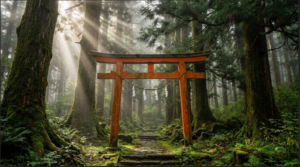
Executive Briefing: Cleansing the Mirror of the Primordial Heart
In Japanese indigenous metaphysics, spiritual pathology is understood not as an indelible inherited stain of original sin requiring forensic salvation, but through the relational polarity of Harae Purification and Kegare. Human nature (*seimei-shin*) is conceived as innately luminous, transparent, and pure, like a polished bronze mirror. Contact with illness, death, trauma, or emotional stagnation deposits spiritual dust (*kegare*) upon that mirror, which is cleansed through ritual lustration (*harae*).
Table of Contents
1. Harae Purification and Kegare: Ontological Cleanliness vs. Moral Sin
The philosophical divergence between Shinto animism and Abrahamic ethical monotheism is crystallized in how each system frames human fallibility. In Western theological traditions stemming from Augustine, humanity inherits an intrinsic moral rupture (original sin) that corrupts the will. Conversely, in Shinto, human beings are children of the kami (*shinshi*), inherently sharing in divine life. Moral failure and misfortune are not ontological defects of essence, but external pollutants (*tsumi* and *kegare*) obscuring an otherwise pure inner reality.
Because pollution is external and situational rather than constitutional, redemption does not require eternal confession or divine pardon; it requires ritual washing, airing, and energetic recalibration. Harae encompasses an extensive family of ritual technologies aimed at sweeping away physical, social, and spiritual impediments, allowing the unobstructed flow of vital creative energy (*musubi*).
2. The Morphology of Kegare: Energy Depletion and Stagnant Pollution
Etymologically, Japanese folklorists such as Orikuchi Shinobu and Yanagita Kunio analyzed kegare as a compound of ki-kare, meaning the “withering or depletion of spirit.” It describes an entropic condition where life-force becomes stagnant, weary, or desensitized. The primary triggers of kegare in ancient legal codes (*Engishiki*) were physical contact with biological decay: childbirth, bloodshed, disease, and corpses.
Far from a punitive moral condemnation, contact with death caused kegare because it placed the living in dangerous proximity to dissolution. A person undergoing bereavement was expected to observe a period of domestic seclusion (*kanko*), refraining from shrine entry not out of guilt, but to allow their depleted spirit to recuperate without compromising the vibrant life-energy of the communal sanctuary.
3. The Liturgy of Misogi: Waterfall Austerities & Daily Temizuya Basins
The most rigorous expression of purification is misogi shūhō (water austerity), rooted in the mythical paradigm of the creator Izanagi bathing in the river to cleanse himself of underworld defilement. Practitioners, dressed in simple white linen robes (*shiro-shozoku*) symbolizing pristine innocence and death to ego, perform vigorous breathing exercises (*furitama* and *torifune*) before immersing themselves under cascading mountain torrents.
At the mundane community level, every visit to a Shinto shrine begins at the water pavilion (*temizuya*). Worshippers utilize wooden ladles to pour cold spring water over their left hand, then right hand, and rinse their mouth before approaching the kami. This simple bodily etiquette serves as a psychological palate cleanser, demarcating entry into sacred precincts.
4. The Grand Purification (Ōharae): Biannual Liturgical Purging & Katashiro Dolls
Twice annually—on June 30th (the summer solstice threshold) and December 31st (year-end eve)—shrines across Japan celebrate the ancient rite of Ōharae (The Great Purification). Priests recite ancient liturgical incantations (*norito*) dating to the Heian period, invoking celestial and terrestrial spirits to blow communal impurities out to sea and drag them down into the oceanic abyss.
Parishioners rub human-shaped paper effigies (*katashiro* or *hitogata*) against their bodies and breathe upon them three times, transferring accumulated illness, fatigue, and grievances into the paper vessels. The priests subsequently burn the effigies or release them into rivers, ceremonially resetting the psychological clock of the collective community.
5. Modern Cultural Epistemology: Hygiene as Spiritual Aesthetic
The contemporary Japanese cultural obsession with immaculate hygiene, punctual street sanitation, removing shoes at household entrances, and ritual bathhouses (*onsen* and *sento*) cannot be divorced from this millennia-old animistic foundation. Cleanliness in Japan is not merely utilitarian disease prevention; it is an aesthetic and ethical duty that honors the sacred dignity of communal space.
Explore further spiritual frameworks and historical masterclasses across Sapiotic.
For scholarly cross-references on Japanese ethical thought and phenomenology, consult the Stanford Encyclopedia of Philosophy Shinto Hermeneutics Overview.
References
- Bocking, B. (1997). A Popular Dictionary of Shinto. Curzon Press.
- Namiki, H. (1988). Kegare and Purification in Japanese Folk Culture. Tokyo University Press.
- Orikuchi, S. (1955). Complete Works of Shinobu Orikuchi: Shinto Studies. Chūōkōronsha.
- Teeuwen, M., & Scheid, B. (2002). Tracing Shinto in the History of Kami Worship. Japanese Journal of Religious Studies, 29(3-4), 195-207.