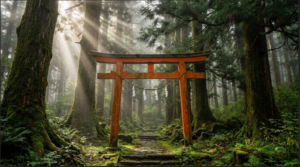
Executive Briefing: The Eight Million Kami (Yaoyorozu no Kami)
Unlike Western theism which conceives of the sacred as a transcendent, omnipotent creator standing outside the created cosmos, Kami Animism Shinto envisions divinity as an immanent, awe-inspiring vital force pulsing directly through the natural world. From ancient moss-covered boulders and primordial waterfalls to sacred towering cryptomeria cedars and ancestral memory, the Japanese spiritual landscape is populated by the myriad spirits (*yaoyorozu no kami*).
Table of Contents
1. Kami Animism Shinto: Philosophical Essence & Etymological Roots
The term kami defies simplistic translation as “god” or “deity.” In his classic eighteenth-century exegesis, the Kokugaku scholar Motoori Norinaga offered what remains the definitive characterization: kami refers to any being, phenomenon, or natural object possessing an extraordinary, awe-inspiring (*kashikoki*), or formidable nature. It encompasses not only benevolent celestial powers, but also thunder, dragons, wolves, towering peaks like Mount Fuji, and even malevolent or disruptive forces.
Rather than demanding moral submission to an external set of codified commandments, Shinto animism cultivates an emotional and bodily responsiveness to the vital energy (*musubi*) generating all existence. Humanity is not the dominion-holding sovereign of nature, but an integral kinsperson born of the same divine creative matrix that brought forth the islands, seas, and trees.
2. Sacred Ecology: Chinju no Mori & Shrine Forest Preservation
The architectural sanctuary of a Shinto shrine (*jinja*) is historically secondary to its natural container: the Chinju no Mori (sacred village grove). Long before wooden halls (*shaden*) were constructed under continental Buddhist influence, ancient Japanese held rituals in open-air natural enclosures where divinity naturally settled.
Ecologists today celebrate Chinju no Mori as invaluable ecological havens. Across thousands of shrines nationwide, these groves have preserved climax primary forest ecologies for over a thousand years, entirely protected from deforestation, agricultural clearance, and urban development. Shinto’s sacred prohibitions against cutting sacred trees (*shinboku*) inadvertently functioned as ancient Japan’s most sophisticated conservation mechanism.
3. Sacred Thresholds: Shimenawa Ropes, Torii Gates, and Iwakura Rocks
In Shinto spatial architecture, the sacred is distinguished from the mundane through subtle, organic signifiers. The shimenawa—a thick, twisted rope of fresh rice straw adorned with zigzag paper streamers (*shide*)—is bound around monumental trees and ancient split boulders (*iwakura*), marking them as divine dwelling places (*yorishiro*) or spiritual landing zones.
Passing beneath the minimalist lintels of a vermilion or unpainted wooden torii gate signifies an ontological transition from the chaotic, polluted profane world into an envelope of pristine stillness. At every threshold, nature is framed not as dead matter awaiting exploitation, but as a vibrant, ensouled cosmos requiring respectful approach.
4. Purity and Defilement: The Dynamics of Misogi & Kegare
At the center of Shinto ritual praxis is the dichotomy between purity (*seimei-shin*) and defilement (*kegare*). Notably, kegare is not equivalent to moral sin or spiritual guilt; it represents a temporary state of energetic depletion, stagnation, or contact with death and illness that separates human consciousness from the flowing vitality of nature.
Purification is accomplished through harae (ritual sweeping) and misogi (water ablution). Worshippers wash their hands and rinse their mouths at the water pavilion (*temizuya*) before approaching the shrine sanctuary. In winter, ascetic practitioners stand beneath freezing mountain waterfalls to strip away psychological detritus and restore clarity to their primordial spiritual core.
5. Environmental Ethics in the Anthropocene: Shinto’s Living Lessons
As the contemporary world confronts planetary biodiversity loss and climate instability, scholars and environmental ethicists have increasingly turned to indigenous animism for regenerative philosophical frameworks. By rejecting human exceptionalism and recognizing the intrinsic rights and consciousness of more-than-human beings, Shinto animism presents a compelling eco-phenomenology capable of inspiring sustainable environmental stewardship.
Explore further ecological philosophies and indigenous masterclasses across Sapiotic.
For scholarly literature on indigenous animism and comparative ecological ethics, visit the Stanford Encyclopedia of Philosophy Environmental Ethics Compendium.
References
- Kasulis, T. P. (2004). Shinto: The Way Home. University of Hawaii Press.
- Ono, S. (1962). Shinto: The Kami Way. Tuttle Publishing.
- Rambelli, F. (2007). Buddhist Materiality: A Cultural History of Objects in Japanese Buddhism. Stanford University Press.
- Miyawaki, A. (2004). Restoration of living environment based on vegetation ecology: Theory and practice. Ecological Research, 19(1), 83-90.