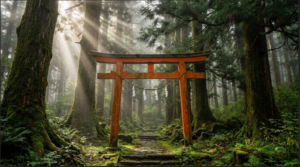
Executive Briefing: The Architecture of Perpetual Rebirth
Deep within the ancient cedar forests of Mie Prefecture, the Ise Jingu Shikinen Sengu represents one of human civilization’s most extraordinary architectural and spiritual traditions. Every twenty years without interruption for over 1,300 years, the grand sanctuaries dedicated to Amaterasu Omikami and Toyouke no Omikami are completely dismantled and rebuilt identical in every minute detail on an adjacent plot, embodying the concept of eternal youthfulness (*Tokowaka*).
Table of Contents
1. Ise Jingu Shikinen Sengu: Historical Genesis Under Empress Jito (690 CE)
The institutional origins of the Shikinen Sengu trace back to the reign of Emperor Tenmu, with the inaugural ceremonial rebuilding executed in 690 CE under his successor, Empress Jitō. Except for a temporary hiatus during the turmoil of the Sengoku civil wars in the fifteenth and sixteenth centuries, the twenty-year cycle has renewed the sanctuaries sixty-two consecutive times across thirteen centuries.
The entire reconstruction undertaking spans approximately eight years from the preliminary rituals to the final relocation (*Sengyo*). Over thirty distinct liturgies accompany each stage: from the felling of ancient sacred timber (*Yamaguchi-sai*), the hauling of river timber through the streets of Ise by thousands of white-clad citizens (*Okihiki*), to the nocturnal procession where the divine spirit (*shintai*) is transferred beneath silk canopies to its pristine new dwelling.
2. Architectural Purity: Shinmei-zukuri Style & Raw Hinoki Cypress
The architectural typology of Ise Jingu, designated Yuiitsu Shinmei-zukuri, represents the purest distillation of indigenous pre-Buddhist Japanese design. Evolving from ancient elevated grain storehouses (*takayuka-shiki kura*), the structures feature thatched roofs of miscanthus reeds (*kaya*), projecting crossed rafters (*chigi*), and horizontal cigar-shaped logs (*katsuogi*) crowning the ridgepole.
Crucially, the buildings are constructed exclusively from unpainted Japanese cypress (*Hinoki*), completely eschewing paint, lacquer, or iron nails. The massive circular pillars are sunk directly into the earth (*hotate-bashira*) rather than resting on stone pedestals. Mortise and tenon wood joinery accommodates the seasonal expansion and contraction of timber, creating a breathing, living structure that ages with organic dignity until its twenty-year renewal cycle arrives.
3. The Philosophy of Tokowaka: Cyclical Rebirth vs. Western Monolithic Permanence
Western architectural preservation has historically prioritized monolithic durability—monuments of marble, granite, and masonry engineered to resist time through material indestructibility. In stark contrast, Shinto metaphysics views physical decay as an inevitable natural law. Eternity is achieved not by freezing material objects in place, but through perpetual rhythmic regeneration, a concept known as Tokowaka (“eternal freshness and youth”).
By regularly dismantling the older pavilion and resurrecting an exact replica beside it, the shrine transcends physical aging. The sixty-second shrine built in 2013 is neither a replica nor an imitation; it is the authentic shrine itself, vibrating with the same pristine vital energy (*seimei-ryoku*) that animated the original sanctuary in the seventh century.
4. Intangible Heritage: Transmitting Millennial Joinery and Craft Mastery
Beyond its spiritual architecture, the twenty-year interval is calibrated to the human life cycle. In any single artisan’s career, they will experience three Sengu rebuilds: once in their youth as an apprentice learning ancient gouging and mortise techniques; once in their prime as a master carpenter (*toryo*) executing critical joinery; and once as an elder statesman passing sacred tacit knowledge down to the next generation.
Concurrently, over 1,500 sacred treasures, divine garments, bronze mirrors, and ceremonial weapons housed within the sanctum are re-fabricated from scratch. Master weavers, metallurgists, lacquerers, and feather-workers must recreate archaic eighth-century artifacts, keeping ancient Japanese material culture alive without breaks in transmission.
5. Modern Environmental Significance & Sustainable Silviculture
Rebuilding two massive main sanctuaries and numerous auxiliary shrines requires over 10,000 prime Hinoki cypress logs, many exceeding 200 years of age. In the modern era, the shrine administrators maintain dedicated sanctuary forests (*Kyūrin*) governed by a 200-year sustainable silviculture management plan. In an age of ecological precarity, Ise Jingu stands as a living testament to long-horizon environmental stewardship and cyclical sustainability.
Explore further cultural masterclasses and structural architectural analyses across Sapiotic.
For international architectural documentation and comparative heritage standards, visit the UNESCO World Heritage Centre Sacred Architecture Archives.
References
- Tange, K., & Kawazoe, N. (1965). Ise: Prototype of Japanese Architecture. MIT Press.
- Adams, C. (1998). Japan’s Ise Shrine and Its Twenty-Year Ritual. Architectural Review, 203(1215), 68-71.
- Nitschke, G. (1993). From Shinto to Ando: Studies in Architectural Anthropology in Japan. Academy Editions.
- Breen, J. (2010). Resurrecting the Past: The Shikinen Sengu at Ise Jingu. Japanese Journal of Religious Studies, 37(1), 69-90.