Executive Briefing: The Beat Poets of Ancient China
During the treacherous Wei-Jin transition of the third century CE, a legendary fraternity of poets, musicians, and philosophers retreated from the blood-soaked intrigues of the imperial court to wander in a bamboo grove in Henan. Known to world history as the Seven Sages Bamboo Grove (*Zhulin Qixian*), these eccentric iconoclasts forged a revolutionary counter-culture celebrating Dionysian freedom, zither improvisation, natural spontaneity (*ziran*), and disdain for corrupt political hypocrisy.
Table of Contents
1. Seven Sages Bamboo Grove: Historical Crucible of the Wei-Jin Transition
The mid-third century CE in China was an era of profound psychological disillusionment. The Han dynasty had fractured into the Three Kingdoms, and the ruling Cao Wei dynasty was being systematically usurped by the ruthless Sima clan (founders of the Jin dynasty). Intellectuals who spoke out were summarily decapitated along with three generations of their kin.
Disgusted by the Sima clan’s cynical manipulation of Confucian moral slogans to justify treason and assassination, seven brilliant nonconformists turned their backs on bureaucratic careers: Ji Kang, Ruan Ji, Shan Tao, Xiang Xiu, Liu Ling, Ruan Xian, and Wang Rong. They gathered at Shanyang, spending their days drinking wine, forging iron beneath willow trees, practicing breath meditation, and engaging in “pure conversation” (*qingtan*).
2. Neo-Taoist Xuanxue: Spontaneity (Ziran) vs. Court Moralism (Mingjiao)
Philosophically, the Sages were leaders of Xuanxue (“Dark Learning” or Neo-Taoism). The central intellectual dilemma of the age was the tension between Mingjiao (the doctrine of names and Confucian social conventions) and Ziran (naturalness, spontaneity, and authenticity).
The Sages argued that Confucian rituals had become corrupted into masks for greedy careerists. Ji Kang famously declared: “I transgress the teachings of the Duke of Zhou and Confucius; I treat the rulers of this world with contempt.” For them, living in accordance with the Tao required casting off ceremonial decorum and following the unscripted impulses of the human heart.
3. Ji Kang and Ruan Ji: The Twin Luminaries of Defiance and Wine
The group was anchored by two extraordinary geniuses:
Ruan Ji (210–263 CE): A master poet who feigned perpetual drunkenness for sixty consecutive days to avoid a politically coerced marriage into the murderous Sima family. Ruan Ji invented the famous “white and black eyes” gaze: when greeted by pompous, hypocritical court officials, he looked at them with cold white sclera; when greeting authentic friends, he looked at them with warm, dark pupils.
Liu Ling: An eccentric who wandered naked in his cottage with a jug of wine, followed by a servant with a spade instructed to “bury me wherever I drop dead.” When shocked visitors reprimanded his nudity, Liu Ling laughed: “Heaven and earth are my roof and pillars; this house is my trousers. What are you gentlemen doing inside my pants?”
4. The Execution Grounds & The Immortal Zither Melody: Guangling San
The tragedy of the circle culminated in the martyr’s death of Ji Kang (223–262 CE). Tall, handsome, and an uncompromising critic of court sycophancy, Ji Kang was framed on trumped-up charges of subversion by a petty court favorite whom he had snubbed while forging iron.
Three thousand imperial academy students petitioned for Ji Kang’s release, but the court condemned him to death. On the execution grounds at the Eastern Marketplace of Luoyang, with thousands of weeping spectators watching the shadow on the sundial shorten, Ji Kang asked for his seven-string zither (*guqin*). He serenely tuned the strings and played the legendary, intricate masterpiece Guangling San. As the final note reverberated, he laid down the instrument and sighed: “The melody of Guangling San is now lost to the world.” He bowed his neck to the executioner’s blade with complete philosophical composure.
5. Artistic Immortality: The Aesthetic of Eccentricity in Chinese Art
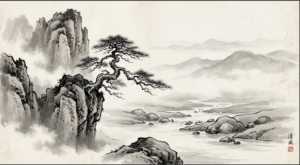
The martyrdom of Ji Kang and the defiant survival of Ruan Ji transformed the Seven Sages into the archetypal cultural saints of Chinese literature and painting. For two thousand years, scholars under despotic dynasties looked to the Bamboo Grove for moral inspiration, painting their portraits on lacquer screens, silk scrolls, and tomb brick reliefs.
Their life proved that the human spirit possesses the aesthetic and spiritual power to preserve inner sovereignty even in the face of brutal political tyranny.
Explore further Taoist philosophy and aesthetic masterclasses across Sapiotic.
For scholarly encyclopedic overviews of the Seven Sages and Wei-Jin intellectual history, visit the Encyclopaedia Britannica Seven Sages of the Bamboo Grove Compendium.
References
- Holzman, D. (1976). Poetry and Politics: The Life and Works of Juan Chi (A.D. 210–263). Cambridge University Press.
- Henricks, R. G. (1983). Philosophy and Argumentation in Third-Century China: The Essays of Hsi K’ang. Princeton University Press.
- Mather, R. B. (2002). Shih-shuo Hsin-yü: A New Account of Tales of the World. University of Michigan Press.
- Spiro, A. (1990). Contemplating the Ancients: Aesthetic and Social Issues in Early Chinese Portraiture. University of California Press.