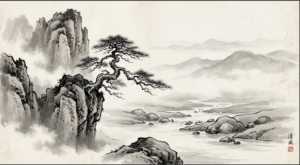
Executive Briefing: Harmonizing Architecture with Telluric Energy
Rooted in millennia of indigenous Taoist cosmological observation, Feng Shui Qi Energy Flows (literally “Wind and Water”) is classical China’s sophisticated science and art of spatial geomancy. Operating on the understanding that the earth is a living organism traversed by invisible telluric currents of vital breath (*Qi*), Feng Shui coordinates architectural placement, urban design, and interior topography to gather life-enhancing energy (*Sheng Qi*) while dissipating harmful, stagnant vortices (*Sha Qi*).
Table of Contents
1. Feng Shui Qi Energy Flows: Theoretical Foundations & The Book of Burial (Zangshu)
The definitive classical formulation of geomancy appears in the fourth-century Zangshu (Book of Burial), attributed to scholar Guo Pu: “Qi rides the wind and scatters, but is retained when encountering water. The ancients collected it so it would not scatter, and guided it so it would be retained. Hence it is called Feng Shui.”
In this Taoist physics, the cosmos is an undulating web of dynamic energy. Fast, gale-force winds tear away the protective vital envelope of living organisms, whereas meandering streams, gentle hills, and protective mountain ranges shelter and accumulate nourishing life-force. Human dwellings—both for the living (*Yangzhai*) and ancestral tombs (*Yinzhai*)—must be positioned in resonance with these natural topological conduits.
2. The Form School (Xingfa): The Four Celestial Animals Landscape Model
Originating in the rugged mountains of Jiangxi, the Form School focuses on tangible landforms: mountain contours, ridgelines (“dragon veins” or *longmai*), and river curves. The ideal auspicious sanctuary conforms to the armchair model of the Four Celestial Animals:
- The Black Tortoise (North / Behind): A steep, imposing mountain range behind the dwelling, providing protective shelter from harsh winter winds and hostile attacks.
- The Green Dragon (East / Left): A high, undulating ridge to the left, channeling benevolent vitality, wisdom, and creative expansion.
- The White Tiger (West / Right): A lower, gentle ridge to the right, safeguarding against sudden aggression and stabilizing material resources.
- The Red Phoenix (South / Front): An open, sunlit valley or meandering river in front (*Minggtang*), welcoming expansive prosperity and solar warmth.
3. The Compass School (Liqi): The Luopan Geomantic Compass & Bagua Grid
Developing in Fujian, the Compass School integrates temporal and astrological dimensions with spatial layout. Practitioners utilize the Luopan—an extraordinarily complex magnetic compass comprising up to forty concentric rings containing the Eight Trigrams (*Bagua*), the Heavenly Stems, Earthly Branches, lunar mansions, and the Nine Flying Stars.
By measuring minute magnetic bearings and factoring in the twenty-year cosmic time cycles (*San Yuan Jiu Yun*), the geomancer diagnoses how energetic currents flux through specific doorways, windows, and hearths, prescribing remedies like mirrors, water features, or realignment to restore domestic balance.
4. Imperial Capitals & Sacred Geography: The Cosmic Grid of Beijing
Far from a private domestic superstition, Feng Shui was the guiding blueprint for imperial Chinese statecraft and civil engineering. The architectural layout of Beijing, the Forbidden City, and the Temple of Heaven represents the world’s most magnificent manifestation of geomantic design.
The city was constructed along a precise north-south meridian axis. North of the Forbidden City, the artificial hill of Jingshan was sculpted from the earth dug from the palace moats, intentionally creating the required “Black Tortoise” back-shield to deflect northern nomadic invasions and malevolent winds, while the Golden Water River curved serenely before the Gate of Supreme Harmony.
5. Modern Environmental Architecture & Sustainable Urbanism
In the twenty-first century, international architectural luminaries—such as I.M. Pei (designer of the Bank of China Tower in Hong Kong) and modern bioclimatic architects—have recognized that classical Feng Shui intuitively encoded fundamental principles of solar orientation, passive airflow ventilation, thermal mass shielding, and flood-plain management.
By blending traditional geomantic sensitivity to topographical contours with contemporary green building science, modern urban planners create environments that are both ecologically sustainable and emotionally restorative.
Explore further spatial aesthetics and environmental philosophy across Sapiotic.
For scholarly history and comparative research on Chinese geomancy and spatial arts, visit the Encyclopaedia Britannica Feng Shui Compendium.
References
- Bruun, O. (2003). Fengshui in China: Geomantic Divination Between State Orthodoxy and Popular Religion. University of Hawaii Press.
- Guo, P. (4th c. / 2004). The Book of Burial (Zangshu): A Translation with Commentary (Translated by Stephen L. Field). Edwin Mellen Press.
- Feuchtwang, S. (2002). An Anthropological Analysis of Chinese Geomancy. White Lotus Press.
- Meyer, J. F. (1978). Feng-shui of the Chinese City. History of Religions, 18(2), 138-155.