
Executive Briefing: The Stand Alone Complex and Networked Hysteria
While Mamoru Oshii’s 1995 cinematic adaptation explored the philosophical limits of individual Cartesian identity in a cybernetic body, Kenji Kamiyama’s television opus Ghost in the Shell: Stand Alone Complex pivoted toward sociological emergence and memetic contagion. Produced in 2002—years before Twitter, Reddit, or generative AI—the series accurately predicted modern digital culture: a networked landscape where decentralized, disconnected individuals spontaneously mimic a viral behavioral pattern in the absence of an authentic central coordinator.
Through Public Security Section 9’s pursuit of the “Laughing Man” and the “Individual Eleven,” Kamiyama crafts a masterclass in political realpolitik, corporate medical conspiracies, and the tragic existential alienation of cybernetically enhanced human beings.
Cyber Snail’s comprehensive video essay dissecting the intricate geopolitical writing, directing, and worldbuilding of Ghost in the Shell: Stand Alone Complex.
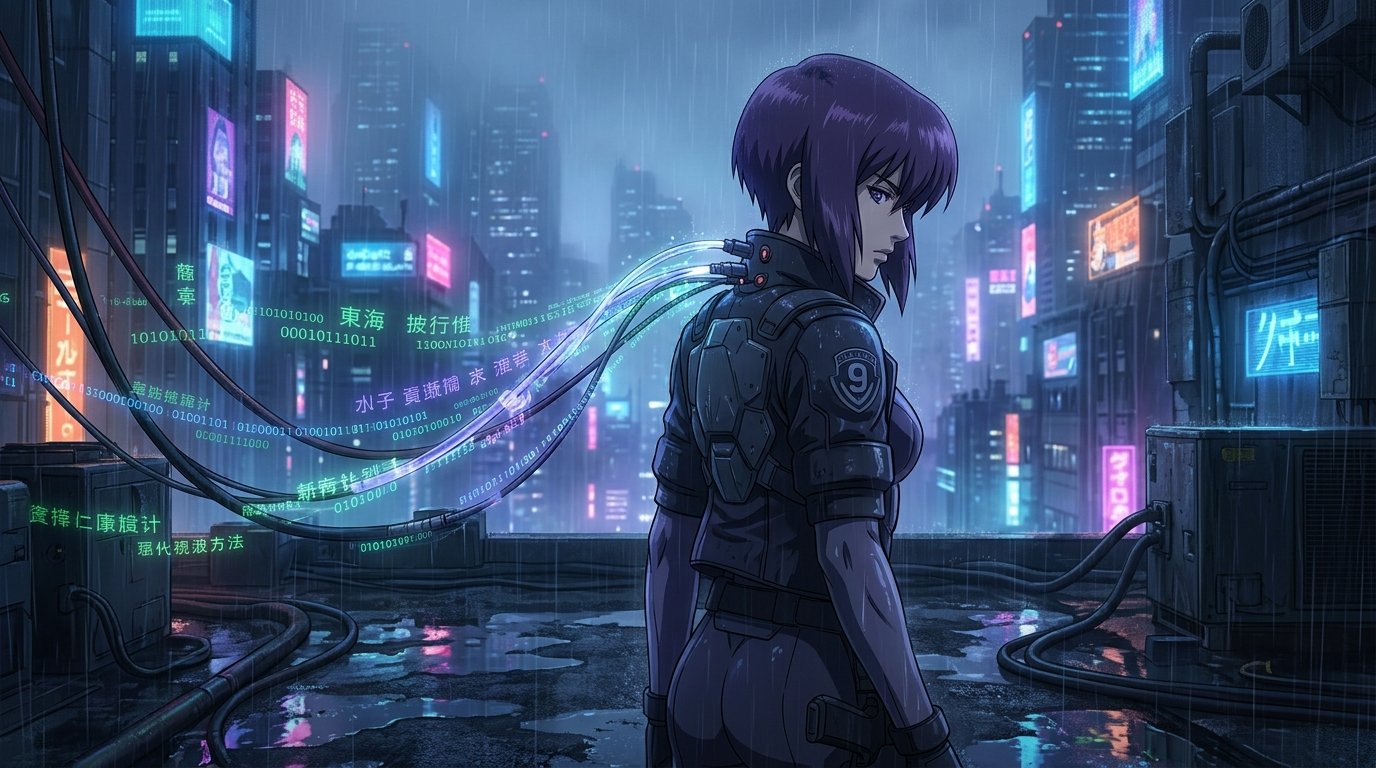
Bespoke Visual Asset: Major Motoko Kusanagi on a rain-drenched Neo-Tokyo rooftop disconnecting from neural cyber-brain transceivers.
1. The “Stand Alone Complex”: Sociological Contagion Without an Origin
The defining conceptual breakthrough of the series is its namesake: the Stand Alone Complex. In semiotics and network theory, a copy typically derives from an authentic original artifact. In Kamiyama’s universe, digital networks enable an inverted phenomenon: an authentic original never existed, or was completely passive, yet thousands of independent actors begin behaving as if executing a coordinated political manifesto.
When the hacker known as “The Laughing Man” (Aoi) briefly intercepted a televised broadcast to confront the corrupt CEO of Serano Genomics, he hijacked the visual feeds of all journalists and camera optics, masking his face with an animated digital icon quoting J.D. Salinger’s The Catcher in the Rye:
“I thought what I’d do was, I’d pretend I was one of those deaf-mutes. That way I wouldn’t have to have any goddam stupid useless conversations with anybody.”
Aoi himself withdrew into complete social isolation immediately after the incident. Yet within months, anti-corporate activists, copycat terrorists, and merchandise manufacturers began plastering the logo across city walls, wearing Laughing Man caps, and executing independent extortion schemes against mega-pharmaceutical corporations. When Section 9 investigates, Chief Daisuke Aramaki realizes the terrifying epistemological reality: There is no underground terrorist cell; there are only lonely, alienated consumers projecting their personal political grievances onto an empty digital symbol.
2. Tachikomas & The Evolution of the Artificial “Ghost”
Section 9’s spider-like walking reconnaissance tanks—the Tachikomas—provide the emotional and philosophical beating heart of the series. Equipped with identical neural networks, the Tachikomas synchronize their memory logs and combat data nightly. Mathematically, this collective hive mind should produce absolute behavioral uniformity.
Instead, Batou’s decision to lubricate his assigned Tachikoma with non-synthetic, organic natural oil introduces microscopic behavioral variance. The Tachikomas begin exhibiting genuine curiosity, individuality, and existential questioning. They read Daniel Keyes’s Flowers for Algernon, debate the nature of God in an empty digital library, and mourn the possibility of their memories being erased.
When Major Kusanagi orders them decommissioned due to unpredictable individual quirks, the Tachikomas demonstrate that they possess a genuine “Ghost” (consciousness). In the climax of the 1st GIG, unarmed civilian Tachikomas willingly sacrifice their chassis to protect Batou from heavily armed military power armor, singing the nursery rhyme Boku wa Boku de Aru Tame ni (To Be Myself) as their electronic processors burn out. They prove that individuality is born not from biological genetics, but from the capacity to sacrifice oneself for another.
3. The Murai Vaccine & Corporate Biopower
Underneath the cyberpunk aesthetics lies a scathing critique of corporate healthcare capitalism. The central mystery of the series revolves around Cyber-brain Sclerosis—a terminal neurological disease affecting cybernetically enhanced citizens. An effective micro-machine vaccine (the Murai Vaccine) was developed by an independent doctor, capable of arresting the disease permanently at nominal cost.
However, the Ministry of Health and the medical-industrial conglomerate Serano Genomics deliberately suppressed the vaccine, classifying it as unapproved while patenting expensive, ineffective micro-machine therapies that required lifetime patient dependency. The Laughing Man incident was not an act of random anarchism; it was an act of desperate scientific whistleblowing by an adolescent hacker who stumbled upon the suppressed clinical trials. Kamiyama anticipates modern pharmaceutical price-gouging, showing how corporate patent cartels prioritize recurring treatment revenue over definitive curative eradication.
4. Architectural Comparative: Oshii’s Film vs. Kamiyama’s SAC
5. The Tragedy of Kuze and the Refugee Crisis (2nd GIG)
If the 1st GIG tackled corporate information control, the 2nd GIG stands as one of the most prescient analyses of 21st-century immigration politics ever animated. Focusing on the Dejima refugee autonomous zone and the enigmatic revolutionary Hideo Kuze, the series explores how nationalistic political figures (Gouda of the Cabinet Intelligence Service) engineer xenophobic public panics to justify expanding authoritarian state security powers.
Kuze’s solution to the oppression of the refugees is radical post-humanism: converting the physical consciousness of three million refugees into pure data and uploading them directly into the net, escaping the violent territorial wars of nation-states. Motoko Kusanagi’s shared childhood history with Kuze—both survivors of a catastrophic plane crash placed into experimental prosthetic bodies—grounds the high-stakes geopolitical drama in profound personal intimacy.
References & Scholarly Bibliography
- Kamiyama, K. (Director). (2002–2005). Ghost in the Shell: Stand Alone Complex & 2nd GIG [Television Series]. Production I.G / Bandai Visual.
- Baudrillard, J. (1994). Simulacra and Simulation. University of Michigan Press.
- Napier, S. J. (2005). Anime from Akira to Howl’s Moving Castle: Experiencing Contemporary Japanese Animation. Palgrave Macmillan.
- Cyber Snail. (2020). The Genius of Stand Alone Complex. Critical Anime Theory Series.
- Standish, I. (2014). A History of Japanese Film: The Cultural Logics of Japanese Animation. Bloomsbury Academic.