
Executive Briefing: The Fallacy of Equivalent Exchange
At the core of Hiromu Arakawa’s Fullmetal Alchemist: Brotherhood lies one of the most profound interrogations of scientific rationalism and industrial militarism in modern narrative fiction. While the young Elric brothers initially idolize the alchemical dogma of Equivalent Exchange (To obtain something, something of equal value must be lost), the narrative systematically dismantles this principle as an incomplete, utilitarian delusion.
By sacrificing his own Gate of Truth—the physical and cosmic source of his alchemical omnipotence—Edward Elric commits the ultimate act of anti-capitalist, non-transactional devotion: voluntarily becoming an ordinary, vulnerable human to pull his brother Alphonse back into the corporeal world. The story proves that genuine human connection, collective labor, and ethical reconciliation cannot be computed on an alchemical balance sheet.
Wisecrack’s seminal video essay analyzing the philosophical conflict between secular materialism and moral transcendence in Fullmetal Alchemist.
1. The Metaphysics of Equivalent Exchange vs. Spiritual Economy
Alchemy in the state of Amestris is ostensibly governed by rigorous natural laws analogous to Lavoisier’s conservation of mass and thermodynamics. Matter cannot be created from nothing; an alchemist must comprehend the atomic structure of an object, deconstruct it, and reconstitute it into a form with identical elementary mass. For the child prodigy Edward Elric, this mechanistic worldview offered an intoxicating promise: every problem in the universe could be resolved through mathematical calculation and sufficient willpower.
The tragedy of human transmutation—the forbidden attempt to resurrect their deceased mother, Trisha Elric—violently shatters this Newtonian certainty. The chemical breakdown of an average adult human body (35 liters of water, 20 kilograms of carbon, 4 liters of ammonia, 1.5 kilograms of lime, 800 grams of phosphorus, 250 grams of salt, 100 grams of saltpeter, 80 grams of sulfur, 7.5 grams of fluorine, 5 grams of iron, 3 grams of silicon, and traces of 15 other elements) can be purchased for mere pennies on a marketplace. Yet, combining these physical elements yields only a grotesque, dying homunculus that asphyxiates within moments.
“What could equal the value of a human soul? It was foolish arrogance to believe that a mother’s warmth and memories could be purchased with pocket change and chalk circles.” — Edward Elric
In penalizing the boys, the entity known as Truth exacts a toll calculated with cosmic, punitive irony: Edward’s left leg (the physical foundation of standing on one’s own two feet) and Alphonse’s entire body (leaving him suspended in cold iron armor, unable to feel warmth, hunger, pain, or human touch). Truth does not punish out of petty malice, but as an impassive mirror: reflecting human hubris back onto those who dare equate the sacred miracle of human consciousness with base industrial matter.
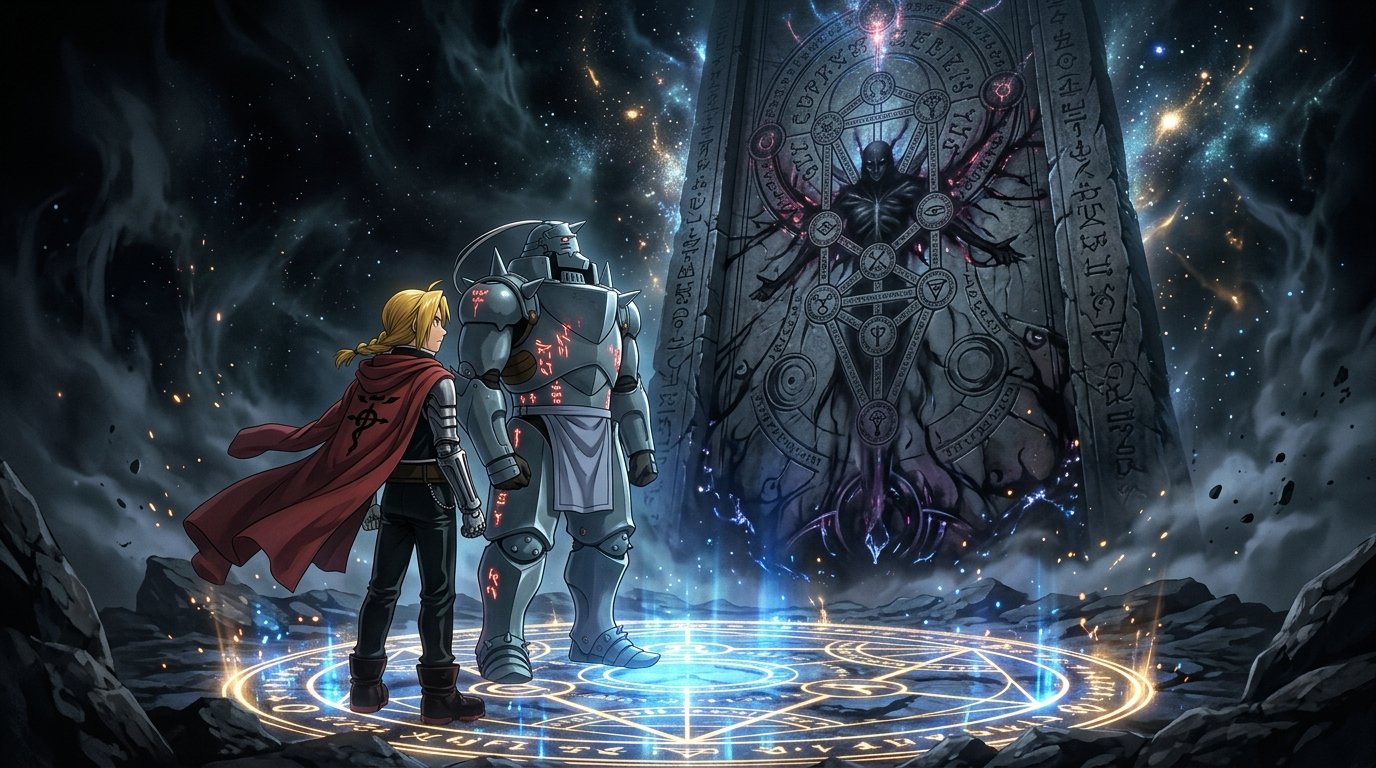
Bespoke Visual Reconstruction: Edward and Alphonse Elric standing before the Tree of Life on the Alchemical Gate of Truth.
2. Amestris as a Militaristic Fascist State: The Ishvalan Genocide and Historical Guilt
Unlike conventional shonen anime where the state military apparatus functions as a benevolent institutional protector, Brotherhood models the government of Amestris directly on early-20th-century Prussian militarism and Imperial Japan. State Alchemists are formally designated as “Human Weapons”, issued silver pocket watches inscribed with military rank, and subordinated to the command of the Führer, King Bradley.
The defining historical trauma of the series is the Ishvalan Civil War—a protracted military campaign that devolved into systemic ethnic cleansing. In Episode 30, Arakawa deconstructs the moral degradation of soldiers ordered to exterminate civilians. State Alchemists who entered the service under idealistic scientific aspirations (Roy Mustang, Riza Hawkeye, Alex Louis Armstrong) were deployed to obliterate residential sectors, converting sacred alchemical knowledge into weapons of mass terror.
Arakawa’s handling of postwar accountability is unprecedented in the anime medium:
- Rejection of Convenient Amnesia: Roy Mustang and Riza Hawkeye do not seek heroic absolution. Mustang explicitly intends to democratize the nation, institute civilian trials, and willingly face a war crimes military tribunal once Amestris is stabilized.
- The Vengeance Trap (Scar): Scar’s transformation from an Ishvalan warrior into a serial assassin targeting State Alchemists mirrors the toxic, self-perpetuating cycle of retributive justice. His redemption occurs only when he abandons the quest for blood and joins hands with Amestrian soldiers to preserve Ishvalan architectural and theological records.
- The Philosopher’s Stone as Exploitative Commoditization: The ultimate secret of the Philosopher’s Stone is that it is not mineral ore; it is distilled human life. Thousands of Ishvalan prisoners and Amestrian citizens were liquefied into crimson catalysts to feed the immortality of ruling elites—a brutal visual allegory for how authoritarian regimes treat living working bodies as disposable fuel for imperial power.
3. Father and the Seven Homunculi: The Hubris of Severing Human Flaws
The primary antagonist, known simply as Father (the Dwarf in the Flask), originated as a shapeless shadow birthed from the blood of Hohenheim in ancient Xerxes. Father’s existential ambition is to become a complete divine being by purging himself of all mortal weaknesses: the Seven Deadly Sins (Lust, Gluttony, Envy, Wrath, Sloth, Greed, and Pride).
The grand philosophical irony is that by excising his sins, Father did not become divine—he became an empty, sterile vessel devoid of empathy, warmth, and resilience. Human beings are noble precisely because of their contradictions, limitations, and internal struggles.
4. Comparative Analysis: 2003 Original Anime vs. 2009 Brotherhood
Few creative franchises possess two distinct, full-length anime adaptations of such towering quality. Understanding the divergence between the Seiji Mizushima 2003 series and Yasuhiro Irie’s 2009 Brotherhood illustrates how foundational narrative architecture shapes thematic resonance:
5. The Final Transmutation: Relinquishing the Gate
In Episode 63, Edward Elric stands before the white silhouette of Truth one final time to retrieve Alphonse’s physical soul and body. Truth smirks and presents the impossible ultimatum: “What will you pay to pull a whole human being back from the void?”
Edward points behind him at the monumental, intricately carved stone monolith that represents his personal Gate of Truth—the vessel of all his alchemical knowledge, power, and genius. He declares that he will give up his Gate in exchange for his brother.
Truth challenges him: “If you give up your Gate, you will become an ordinary human. You won’t be able to use alchemy ever again. Are you sure you can accept being just an insignificant, powerless human?”
Edward’s response constitutes the emotional and philosophical climax of the entire 64-episode opus:
“Even without alchemy, I’ve still got everyone. Alchemy never brought my mother back. It didn’t save Nina. It only brought misery when I tried to use it to play God. I was always just a human being… I was never anything more than that!”
For the first time in cosmic history, Truth smiles with genuine delight, bursting into laughter: “That’s the right answer! You’ve beaten me! Take him with you!”
In this moment, Arakawa delivers her definitive thesis: true maturity is not the accumulation of absolute power, wealth, or technological mastery. True maturity is recognizing the sacred dignity of human limitation, accepting vulnerability, and trusting in the mutual support of community. By discarding the illusion of Equivalent Exchange, Edward discovers grace.
References & Scholarly Bibliography
- Arakawa, H. (2001–2010). Fullmetal Alchemist (Vols. 1–27). Square Enix / VIZ Media.
- Napier, S. J. (2005). Anime from Akira to Howl’s Moving Castle: Experiencing Contemporary Japanese Animation. Palgrave Macmillan.
- Clements, J., & McCarthy, H. (2015). The Anime Encyclopedia: A Century of Japanese Animation (3rd Edition). Stone Bridge Press.
- Wisecrack. (2017). The Philosophy of Fullmetal Alchemist: Brotherhood – Wisecrack Edition. Wisecrack Philosophy Series.
- Cavallaro, D. (2007). Anime and the Visual Novel: Narrative Structure, Design and Style at the Digital Intersection. McFarland.