As enterprise technology organizations transition away from fragmented bespoke DevOps scripts toward standardized Internal Developer Platforms (IDPs), the Cloud DevOps & Platform Engineering Lead has emerged as the most critical infrastructure leadership appointment in India. Commanding total compensation packages ranging from ₹40 Lakhs to over ₹75 Lakhs CTC across Bengaluru, Hyderabad, and the National Capital Region (NCR), these platform leaders design self-service developer portals, orchestrate multi-tenant Kubernetes clusters, enforce automated FinOps cost governance, and manage zero-downtime GitOps continuous delivery pipelines.
1. The 2026 Evolution: From DevOps Scripting to Platform Engineering
Between 2018 and 2023, development teams were expected to manage their own cloud infrastructure, leading to fragmented Terraform configurations, sprawling cloud billing, and severe developer cognitive overload. In 2026, premier technology enterprises build dedicated platform teams whose mission is to deliver golden paths—standardized, automated self-service environments that allow software engineers to deploy microservices securely without managing raw cloud primitives.
Core Architectural Disciplines in 2026
- Internal Developer Platforms (Backstage & Port): Creating unified self-service catalogs where engineers provision secure environments, databases, and CI/CD pipelines in minutes.
- Declarative GitOps (ArgoCD & Crossplane): Managing infrastructure-as-code and application states purely through Git version control with automated drift reconciliation.
- eBPF & Advanced Service Meshes (Cilium & Istio): Implementing kernel-level network security, mutual TLS (mTLS), and dynamic observability without sidecar overhead.
- Cloud FinOps & Unit Economics: Integrating automated resource right-sizing (Kubecost) and spot instance orchestration to slash cloud spending by 35%+.
2. System Architecture: The Cloud-Native Platform Blueprint
The end-to-end framework connecting developer code commits to self-healing multi-cloud Kubernetes clusters is illustrated below:
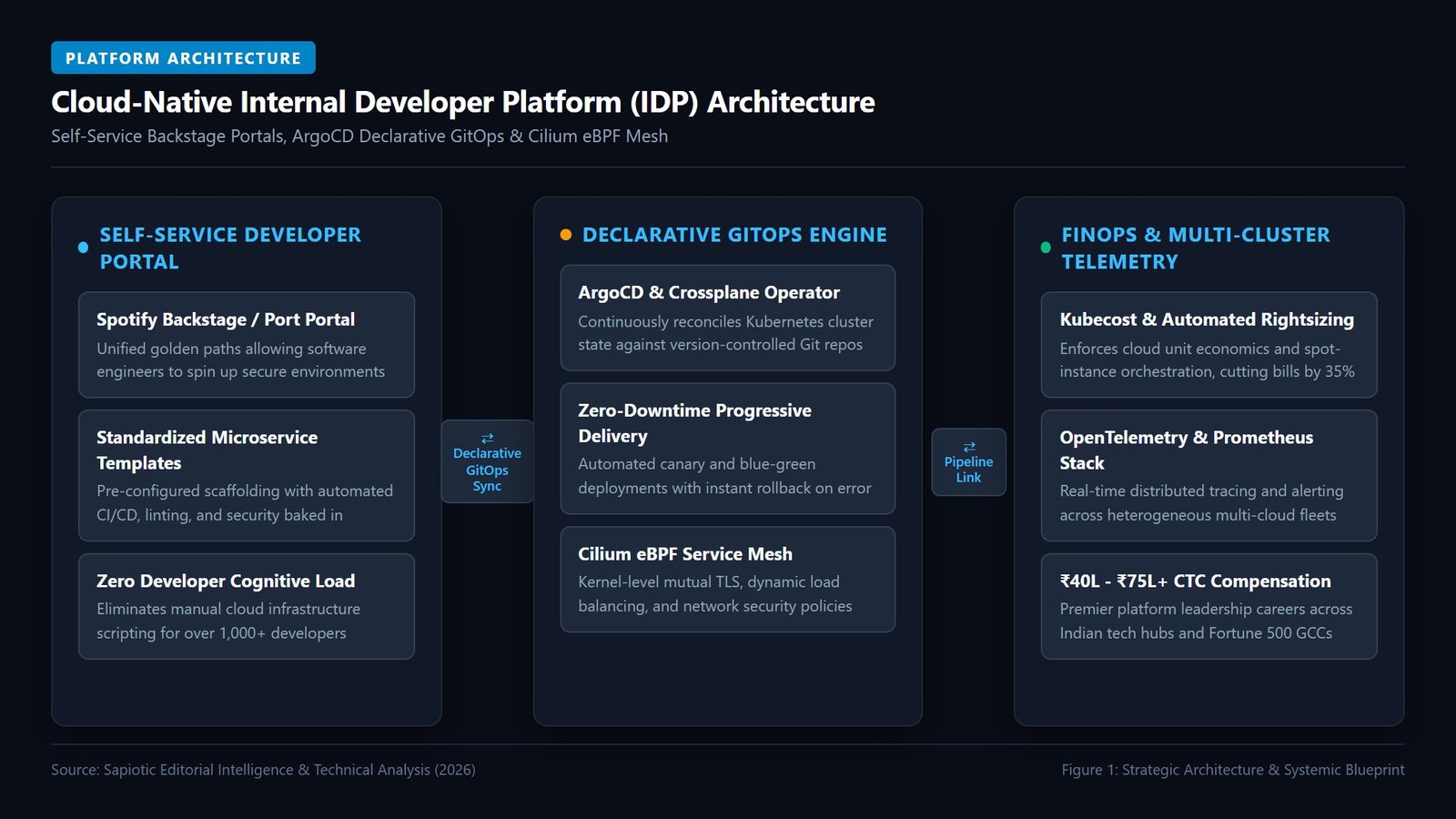
As diagrammed above, developers interact with an intuitive self-service portal, triggering declarative GitOps pipelines that provision isolated namespace environments, enforce zero-trust network policies via Cilium eBPF, and continuously report real-time cost telemetry back to engineering leadership.
3. 2026 Indian Compensation & GCC Market Benchmarks
Remuneration for platform engineering leadership reflects high enterprise competition across major tech corridors:
| Experience Tier / Title | Fixed Annual Base (INR) | Variable Performance / Bonus | Total Annual CTC Package | Primary Tech Cities |
|---|---|---|---|---|
| Senior Platform Engineer (5–8 Yrs) | ₹24,00,000 – ₹32,00,000 | ₹4,00,000 – ₹8,00,000 | ₹28,00,000 – ₹40,00,000 | Pune, Chennai, Gurugram |
| Lead Platform Architect (8–12 Yrs) | ₹38,00,000 – ₹52,00,000 | ₹8,00,000 – ₹18,00,000 | ₹46,00,000 – ₹70,00,000 | Bengaluru, Hyderabad |
| Director of Infrastructure / FinOps (12+ Yrs) | ₹58,00,000 – ₹80,00,000+ | ₹20,00,000 – ₹40,00,000+ (RSUs) | ₹78,00,000 – ₹1.2+ Crore | Bengaluru (ORR/Whitefield), NCR |
4. Technical Interview & Architecture Evaluation
Senior hiring panels at top GCCs and unicorns evaluate platform leads across three demanding technical assessments:
- Multi-Region Disaster Recovery & Failover: Designing an active-active Kubernetes multi-cluster mesh across AWS and Azure that tolerates full datacenter region failure with zero data loss (RPO=0, RTO < 2 minutes).
- FinOps Automated Rightsizing: Formulating automated Karpenter / Cluster Autoscaler policies to dynamically mix spot instances, on-demand nodes, and reserved instances without disrupting latency-sensitive workloads.
- Zero-Trust Identity Federation: Implementing SPIFFE/SPIRE for cryptographic workload identity attestation across heterogeneous Kubernetes and legacy virtual machine fleets.
Related Research & Authoritative Analyses
- › UPSC Civil Services Exam (CSE) 2027 Strategy: Prelims CSAT, Mains GS & Cadre Allotment
- › Footwear Designer Jobs in Dubai: Luxury Fashion Studio via RTC-1 & Application Guide
- › FPSC CSS Exam 2027 Strategy: MPT Screening Test, Compulsory Papers & Scoring Optionals
- › Cloud Solutions Architect: The Complete 2026 Guide to AWS/GCP Multi-Cloud Systems, Certifications & Hiring Pipelines
🔥 Related High-Demand Job Openings
Explore verified employment vacancies across the UAE, Saudi Arabia, and International projects:


