India’s transportation infrastructure entered a revolutionary modern era in 2026 as the nation’s flagship Mumbai–Ahmedabad High-Speed Rail (MAHSR) Corridor commenced live passenger trials. Built in close technical and financial partnership with Japan International Cooperation Agency (JICA), this 508-kilometer bullet train corridor brings Japan’s world-renowned E5-Series Shinkansen technology to the subcontinent, operating at top speeds of 320 km/h and slashing travel time between India’s financial capital and Gujarat’s commercial hub from over six hours to just 1 hour and 58 minutes.
1. The Engineering Feats of the 508-Kilometer Corridor
Administered by the National High Speed Rail Corporation Limited (NHSRCL), the bullet train project represents the most complex civil engineering undertaking in independent India’s history. Over 80% of the route traverses elevated viaducts constructed using massive 40-meter full-span launching gantries, minimizing ground-level land fragmentation and eliminating dangerous grade-level rail crossings entirely.
Cornerstone Engineering Breakthroughs in 2026
- Thane Creek Undersea Tunnel: A 21-kilometer tunnel section, including 7 kilometers traversing directly beneath Thane Creek, excavated using specialized 13-meter diameter mixshield Tunnel Boring Machines (TBMs).
- Japanese J-Slab Ballastless Track: Fabricating tens of thousands of high-precision pre-cast reinforced concrete track slabs designed to maintain microscopic alignment tolerances under extreme thermal expansion.
- DS-ATC Safety & Disaster Prevention: Implementing Digital Automatic Train Control (DS-ATC) paired with UrEDAS (Urgent Earthquake Detection and Alarm System) that automatically cuts power and applies emergency brakes within milliseconds of seismic P-wave detection.
2. Civil & Mechanical Architecture: Shinkansen System Integration
The complete alignment layout from Mumbai’s Bandra Kurla Complex (BKC) underground terminal to Sabarmati is diagrammed below:
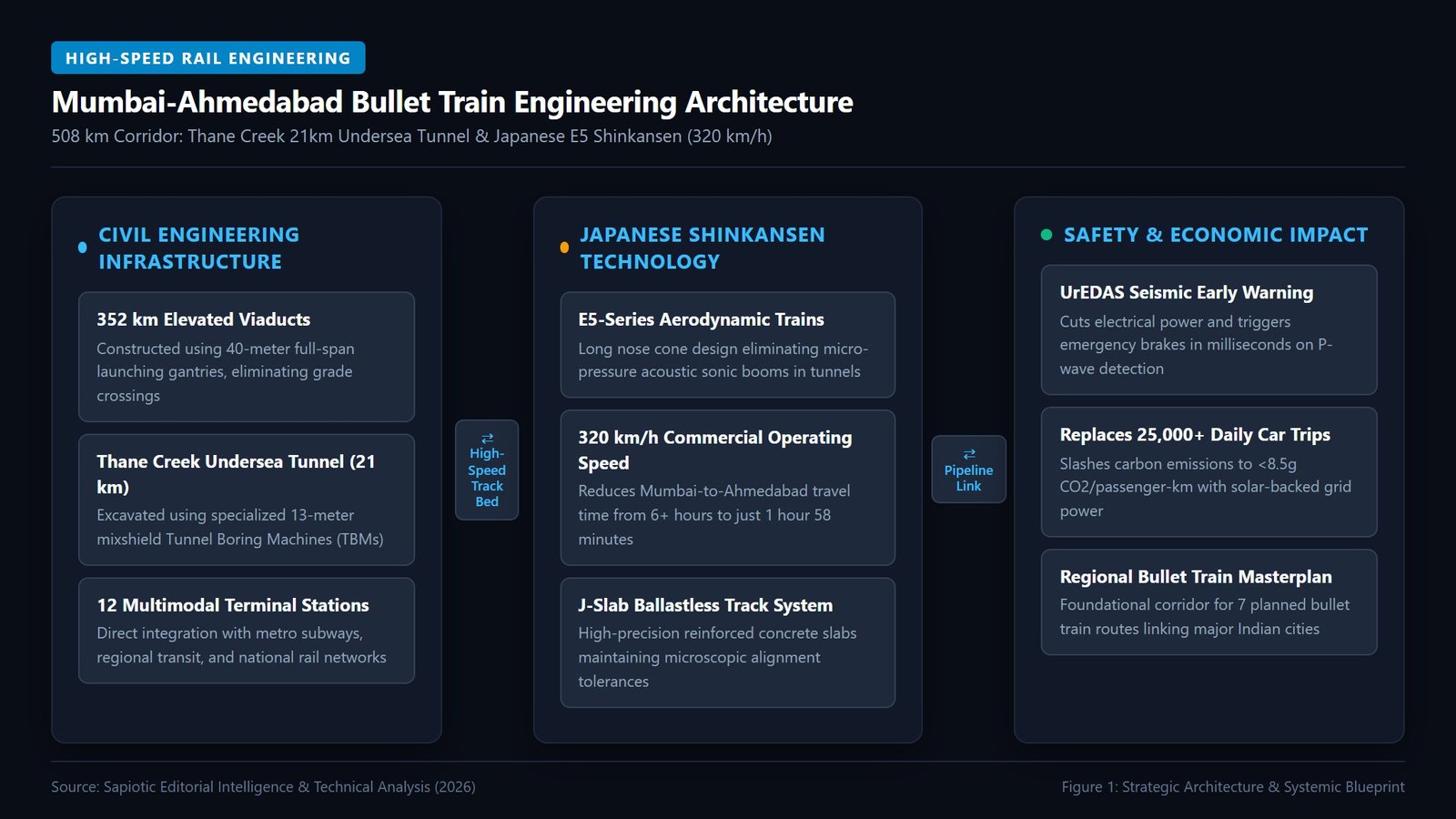
As visualized above, 12 state-of-the-art stations integrate high-speed rail with existing metropolitan subway lines, regional bus rapid transit (BRT), and national rail networks, creating multimodal transit hubs across Maharashtra and Gujarat.
3. Economic & Environmental Impact Analysis
The operational economics of high-speed rail transform regional commerce while delivering massive decarbonization benefits:
| Performance Metric | Conventional Rail / Highway | MAHSR Shinkansen Bullet Train | National Economic Benefit |
|---|---|---|---|
| Travel Duration | 6 to 7 hours | 1 hour 58 minutes (Limited Express) | Enables same-day bilateral executive business commutes |
| Operating Speed | 110 – 130 km/h max | 320 km/h (Design 350 km/h) | Triples passenger throughput per hour |
| Carbon Footprint per Passenger-km | ~68g CO2 (Road) / 140g (Air) | < 8.5g CO2 (Renewable Grid Powered) | Eliminates millions of tonnes of transportation carbon |
| Highway Traffic Reduction | Severe congestion on NH-48 | Replaces 25,000+ daily road trips | Dramatically reduces road accidents and petroleum imports |
4. The National High-Speed Rail Grid Vision
The successful commissioning of the Mumbai-Ahmedabad corridor has established the industrial supply chain for India’s national high-speed master plan. The Ministry of Railways has fast-tracked detailed project reports (DPRs) for seven additional bullet train corridors—including Delhi-Varanasi, Delhi-Ahmedabad, Chennai-Bengaluru-Mysuru, and Mumbai-Nagpur—positioning high-speed rail as the backbone of India’s 21st-century economic integration.
Related Publications & Curriculum Pillars



Related Research & Authoritative Analyses
- › UK Defence Investment Plan & Maritime Security: Autonomous Systems, NATO & Trade Corridors
- › UAE and Saudi Sovereign AI Data Centers: Complete Cloud Infrastructure and Colocation Setup Guide
- › What If Earth’s Magnetic Field Flipped in a Single Decade? Geomagnetic Reversals and Technological Vulnerability
- › UK Semiconductor Strategy & Compound Fab Cluster 2026: South Wales CSconnected, Gallium Nitride (GaN) Power Chips & Sovereign Defense Supply