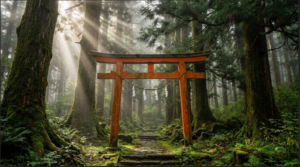
Executive Briefing: The Regalia of Divine Lineage
The Three Sacred Treasures (Sanshu no Jingi)—the Yata no Kagami (mirror), the Kusanagi no Tsurugi (sword), and the Yasakani no Magatama (jewel)—constitute the legendary imperial regalia of Japan. Kept strictly concealed from public sight in sacred shrines, they represent the divine mandate bestowed by the sun goddess Amaterasu upon the imperial lineage.
Table of Contents
The cultural and spiritual significance of the Three Sacred Treasures Japan embodies the world’s oldest continuous hereditary monarchy, bridging archaic Shinto cosmogony with modern constitutional statecraft.
Three Sacred Treasures Japan: Mythological Descent & Kojiki Origins
According to the eighth-century chronicles Kojiki and Nihon Shoki, the supreme sun goddess Amaterasu Ōmikami presented the three treasures to her grandson Ninigi-no-Mikoto when dispatching him from the High Plain of Heaven (Takamagahara) down to pacify the terrestrial islands of Japan. Ninigi’s great-grandson, Emperor Jimmu, established the imperial throne in 660 BCE, cementing the regalia as the indispensable insignia of legitimate sovereign rule.
Symbolism of the Three Artifacts: Wisdom, Valor, and Benevolence
In classical Shinto and Confucian synthesis, the three physical treasures embody the three cardinal virtues of sovereign governance:
- Yata no Kagami (The Eight-Span Mirror): Symbolizes wisdom, honesty, and self-reflection. Amaterasu commanded that the mirror be regarded as her living presence: reflecting truth without distortion.
- Kusanagi no Tsurugi (The Grass-Cutting Sword): Symbolizes courage, valor, and judicial discernment. Recovered from the tail of the eight-headed serpent Yamata no Orochi by Susanoo, it represents military might tempered by righteousness.
- Yasakani no Magatama (The Curved Comma Jewel): Symbolizes benevolence, compassion, and fertility. Carved from jadeite, its organic curved form represents gentle generosity toward the populace.
Sacred Enshrinement: Ise, Atsuta, and the Imperial Palace
Due to their immense sanctity, the physical originals are housed across historic sanctuaries. The original mirror resides at the Grand Shrine of Ise; the sword is enshrined at Atsuta Shrine in Nagoya; and the curved jewel is preserved in the Kashiko-dokoro sanctuary inside the Tokyo Imperial Palace, accompanied by replica sets of the mirror and sword.
The Senso & Sokui Enthronement Ceremonies in Modern Constitutional Law
During the imperial accession rites (most recently for Emperor Naruhito in 2019), the Kenji-tō-Shōkei-no-Gi ceremony transfers the sword, the jewel, and the state seals to the new sovereign. Kept sealed in silk-wrapped boxes, no cameras, historians, or even emperors are permitted to gaze upon the relics directly, maintaining their mystical aura in an age of digital transparency.
Frequently Asked Questions
Has anyone photographed the Three Sacred Treasures?
No. Strict religious taboos prohibit visual reproduction or physical exhibition; they remain permanently enveloped in consecrated textile layers inside lacquered caskets.
For canonical historical archives, consult the Stanford Encyclopedia of Philosophy: Japanese Historical Philosophy.
Explore cultural aesthetics in our guide on Mono no Aware & The Pathos of Transience.