With the operational ramp-up of the Gaganyaan Human Spaceflight Mission, the development of the Bharatiya Antariksha Station (BAS), and the complex orbital mechanics of Chandrayaan-4 lunar sample return, recruitment for Scientist/Engineer ‘SC’ (Space Systems & Satellite Propulsion) at the Indian Space Research Organisation (ISRO) has reached unprecedented national prominence in 2026. Joining India’s premier space agency offers young engineers the opportunity to pioneer cryogenic rocket propulsion, autonomous docking mechanisms, and planetary lander guidance systems under prestigious 7th Central Pay Commission Level-10 cadres.
1. The 2026 Indian Space Odyssey: Megamissions in Execution
India’s space exploration roadmap has advanced from cost-effective satellite launching to complex sovereign exploration and crewed spaceflight. ISRO’s operational pipeline in 2026 demands world-class aerospace, mechanical, and avionics talent capable of designing hardware that withstands the extreme vibrational loads of launch and the cryogenic vacuum of deep space.
Priority Flagship Missions Driving Engineering Recruitment
- Gaganyaan Crewed Orbital Flight: Testing the Environmental Control and Life Support System (ECLSS), crew escape tower solid motors, and high-altitude drogue parachute deceleration systems.
- Next-Generation Launch Vehicle (NGLV / Surya): Developing a heavy-lift semi-cryogenic launch vehicle utilizing kerosene-liquid oxygen (LOX-Kerosene) stages capable of delivering 30 tonnes to Low Earth Orbit (LEO).
- Chandrayaan-4 Lunar Sample Return: Orchestrating multi-module docking in lunar orbit to transfer regolith samples back to Earth.
- Bharatiya Antariksha Station (BAS): Designing pressurized habitation modules, robotic berthing arms, and regenerative life-support loops.
2. Propulsion Architecture: Multi-Stage Launch Vehicle Integration
Designing modern rocket stages requires integrating solid boosters, hypergolic liquid core stages, and high-thrust cryogenic engines:
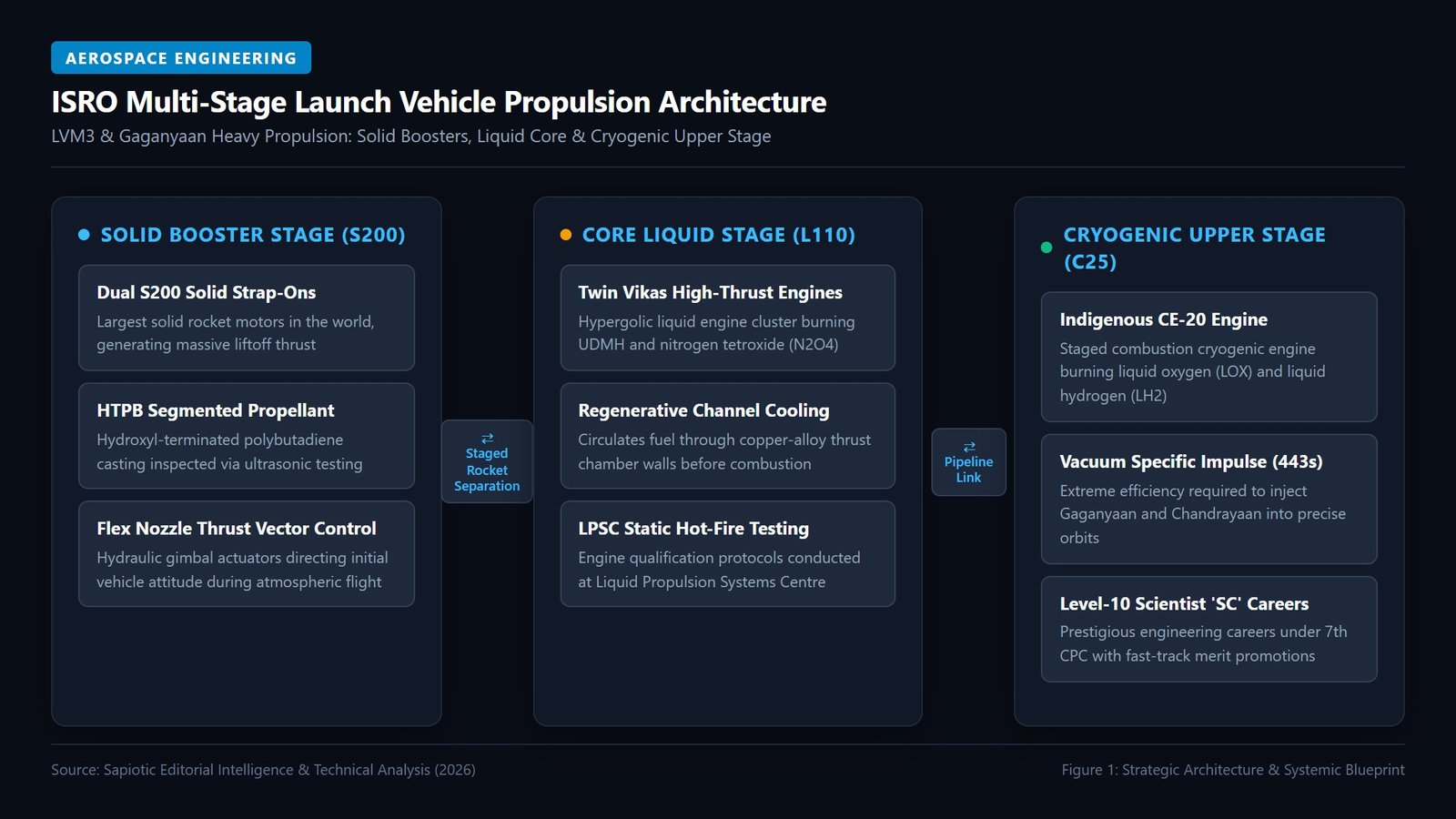
As visualized above, engineers at the Liquid Propulsion Systems Centre (LPSC) and Vikram Sarabhai Space Centre (VSSC) manage the complete propellant feed, turbopump cavitation dynamics, regenerative cooling channels, and gimbaled thrust vector control (TVC) actuators that steer launch vehicles into precision orbital inclinations.
3. ICRB Examination Pattern & Selection Pipeline
Recruitment into ISRO as Scientist/Engineer ‘SC’ is administered centrally through the ISRO Centralised Recruitment Board (ICRB):
| Selection Stage | Format / Weightage | Core Engineering Disciplines | Evaluation Criteria |
|---|---|---|---|
| Stage 1: Written Screening Test | 80 MCQs (75% Discipline Core, 25% Aptitude) | Aerodynamics, Thermodynamics, Fluid Mechanics, Heat Transfer, Machine Design | GATE-standard conceptual depth, negative marking (1/3 mark) |
| Stage 2: Technical Interview | 100 Marks (1:5 candidate ratio) | Project viva, fundamental physics derivation, stress analysis, fluid transients | Mandatory minimum 60% score for final empaneled recommendation |
| Stage 3: Medical Fitness & Security | Qualifying | Class-I physical benchmarks, color vision, background verification | Statutory prerequisite for high-security defense space installation entry |
4. Pay Matrix, Professional Emoluments & Perks (Level 10)
Inducted scientists are placed in Level 10 of the 7th Central Pay Commission (7th CPC) pay matrix. The initial basic pay is ₹56,100 per month, which with current Dearness Allowance (DA), House Rent Allowance (HRA at 30% in Class-X cities like Bengaluru), Transport Allowance (TA), and specialized Space Department allowances results in a gross monthly remuneration of approximately ₹95,000 to ₹120,000. Beyond monetary pay, ISRO provides dedicated departmental residential quarters (CHSS medical scheme offering 100% free healthcare for dependents, subsidized canteen facilities, and internal merit-based fast-track promotion reviews under the Flexible Complementing Scheme (FCS) enabling progression to Scientist ‘SG’ and ‘Outstanding Scientist’ without vacancy limitations.
Related Research & Authoritative Analyses
- › Pakistan Remote Software & DevOps Jobs 2027: Earning USD Safely, PSEB Registration & Tax Rules
- › FPSC Custom Inspector & Intelligence Officer (BS-16) 2026: FBR Anti-Smuggling Blueprint, Syllabus, Physical Standards & Preparation Strategy
- › Australia RegTech, Quant Risk & Data Engineering Jobs 2027: Sydney & Melbourne Banking Pay
- › Fintech Quantitative Risk & Algorithmic Trading Architect (London 2026): High-Frequency C++, FPGA Acceleration & £250,000–£450,000 Total Compensation
🔥 Related High-Demand Job Openings
Explore verified employment vacancies across the UAE, Saudi Arabia, and International projects:


