Physician migration and cross-border clinical practice have entered a decisive new era. In 2026, the international medical licensure roadmap provides clear, standardized pathways for International Medical Graduates (IMGs) seeking full clinical privileges across the world’s premier healthcare jurisdictions: the United States (USMLE), United Kingdom (UKMLA), Australia (AMC), and Canada (MCCQE). Understanding regulatory requirements, examination timelines, and residency matching algorithms is the ultimate determinant of global medical career mobility.
1. The Global Licensure Architecture: Primary Examination Pathways
Each major English-speaking healthcare system has recalibrated its clinical assessment framework to ensure patient safety while addressing acute specialist shortages. While foundational biomedical science remains universally tested, examination structures diverge between pure computer-based multiple-choice formats and intensive Clinical Structured Examinations (OSCEs).
Core Regulatory Pillars Across Jurisdictions
- United States (ECFMG / USMLE): USMLE Step 1 evaluates foundational medical science on a Pass/Fail metric, making USMLE Step 2 CK (Clinical Knowledge) the central quantitative score for NRMP Residency Match competitiveness.
- United Kingdom (GMC / UKMLA): The UK Medical Licensing Assessment consists of the Applied Knowledge Test (AKT) and Clinical and Professional Skills Assessment (CPSA), establishing a uniform benchmark for UK and international candidates alike.
- Australia (AMC): The Australian Medical Council two-part pathway (AMC MCQ + AMC Clinical) unlocks General Registration and supervised hospital internship positions across Australian states.
- Canada (MCC / MCCQE): The Medical Council of Canada Qualifying Examination Part I combined with Canadian clinical experience enables CaRMS residency application eligibility.
2. Comparative Examination & Licensure Workflow
Below is an architectural comparison of the assessment checkpoints, timelines, and clinical readiness evaluations required across each leading destination:
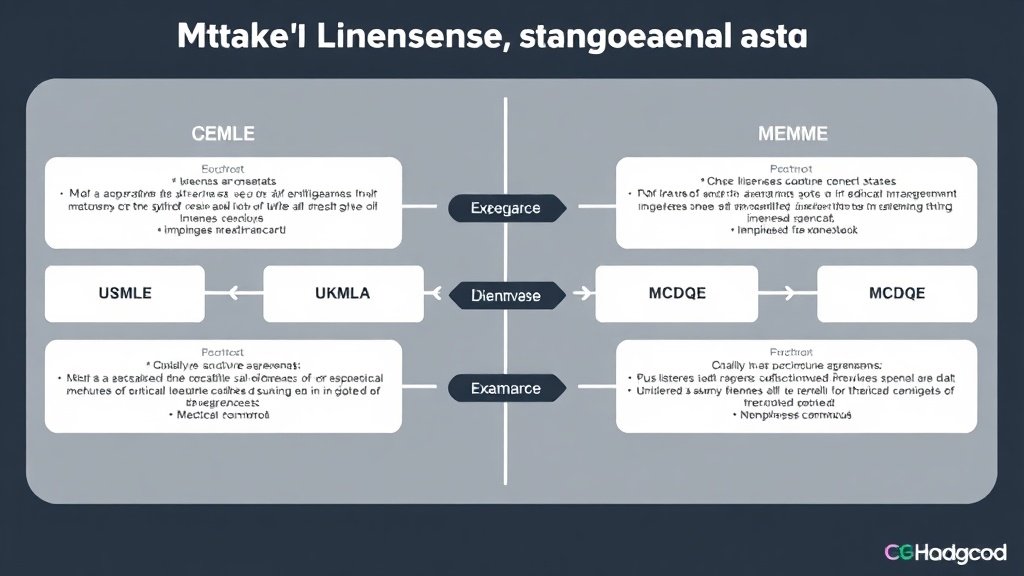
As demonstrated in the comparative pathway matrix above, while the US relies predominantly on three-digit standardized scores to drive competitive residency selection, the UK, Australia, and Canada emphasize standardized clinical simulation assessments before full independent licensure.
3. Comparative Matrix: Costs, Durations & Reciprocity
Physicians must balance significant upfront financial capital and multi-year preparation timelines against long-term clinical earning potential:
| Licensure Track | Core Examinations | Average Timeline | Total Examination Fees | Post-Licensure Compensation (Specialist) |
|---|---|---|---|---|
| US (USMLE / ECFMG) | Step 1, Step 2 CK, OET, ERAS Match | 18 – 24 Months | $4,500 – $7,000 USD | $280,000 – $550,000 USD/year |
| UK (GMC / UKMLA) | UKMLA AKT + CPSA, OET/IELTS | 12 – 18 Months | £2,200 – £3,500 GBP | £95,000 – £160,000 GBP/year |
| Australia (AMC) | AMC MCQ + AMC Clinical Examination | 14 – 20 Months | $5,800 – $8,500 AUD | $220,000 – $450,000 AUD/year |
| Canada (MCC / CaRMS) | MCCQE Part I + NAC OSCE | 16 – 24 Months | $4,200 – $6,800 CAD | $250,000 – $480,000 CAD/year |
4. Step-by-Step Strategic Roadmap for Licensure Clearance
A systematic operational roadmap protects physicians from credentialing invalidation and application delays:
- Phase 1: Primary Source Verification (Epic / ECFMG): Register with official medical credential registries to verify your basic medical qualification (MBBS/MD) through the World Directory of Medical Schools (WDOMS).
- Phase 2: Medical English Language Clearance: Attain high-grade clearance in the Occupational English Test (OET Medicine) with minimum Grade B across all four sub-tests.
- Phase 3: Theoretical Knowledge Examination: Master high-yield question banks (UWorld, Amboss, PassMedicine) to clear USMLE Step 1/2 CK, UKMLA AKT, or AMC MCQ.
- Phase 4: Hands-On Clinical Observerships: Secure hands-on clinical electives or sub-internships in your target country to obtain letters of recommendation from locally licensed senior consultants.
- Phase 5: National Match & Visa Issuance: Submit residency/fellowship applications through centralized portals (ERAS/NRMP in the US, Oriel in the UK, CaRMS in Canada) and transition onto physician work visas (J-1/H-1B, Skilled Worker, Subclass 482).
5. Frequently Asked Questions (FAQ)
Does the USMLE Step 1 Pass/Fail transition make matching more difficult for IMGs?
Yes. With Step 1 scored as Pass/Fail, program directors place decisive weight on the three-digit USMLE Step 2 CK score. IMGs targeting competitive specialties (Cardiology, Surgery, Radiology) generally aim for a Step 2 CK score of 250+ alongside verified US clinical experience.
What replaced the PLAB examination in the United Kingdom?
The UK Medical Licensing Assessment (UKMLA) has unified the licensing examination for all medical practitioners entering the GMC register. International graduates take the UKMLA AKT (multiple-choice theory) and UKMLA CPSA (objective structured clinical exam) in place of PLAB 1 and PLAB 2.
Can medical licenses be transferred directly between Australia and the UK?
Yes. The Australian Medical Council (AMC) and UK General Medical Council (GMC) maintain Competent Authority pathways allowing doctors who completed foundational training in the UK to attain Australian general registration without re-taking initial licensing examinations.
Related Publications & Curriculum Pillars



Related Research & Authoritative Analyses
- ★ Chevening Priority Areas 2026: Official UK Selection Criteria
- › CSS MPT General Abilities: The 15 Invariant Formulas & Speed Blueprints (60 Marks)
- › Global University Admissions & Ivy League Entrance Strategy 2026: SAT, GRE, GMAT & Research Profile Architecture
- › UKMLA CPSA / OSCE Clinical Stations Blueprint: 16 High-Yield Mock Consultations, Calgary-Cambridge Framework, and GMC Marking Rubrics
- › CSS MPT Islamic Studies: The 10 Invariant Chronological & Jurisprudential Blueprints