Table of Contents: Ik Onkar and Radical Equality of Guru Nanak
The theological synthesis of Ik Onkar and Radical Equality of Guru Nanak constitutes one of the most profound spiritual and sociopolitical transformations in human history. Emerging in fifteenth-century Punjab amid deep caste apartheid, religious warfare, and gender subjugation, Guru Nanak (1469–1539) inaugurated an uncompromising spiritual revolution. By anchoring his philosophy in the primal numeral Ik Onkar (The Singular, Indivisible Creative Reality), Nanak established that because the entire cosmos emanates from a single divine source, all artificial human divisions—caste, creed, gender, and social rank—are illusions antithetical to divine truth.
1. Ontological Basis: The Monotheistic Singularity of Ik Onkar
The foundational scripture of Sikhism opens not with an alphabet or linguistic noun, but with a mathematical numeral: “1” (Ik), followed by Onkar (The Eternal Creative Being). By opening the Mool Mantar with a number rather than a word, Guru Nanak established an absolute philosophical barrier against anthropomorphic polytheism and sectarian claims of exclusive divine favor.
In Nanak\’s ontology, God is not an isolated monarch residing in a remote heavenly court; God is both transcendent (Nirgun) and immanent (Sargun), pulsating through every photon, forest, and human heart. If the Divine Light shines equally in all beings, then oppressing, degrading, or scorning any human person is a direct assault on the Creator. For deep inquiries into Asian philosophy and comparative ethics, explore Sapiotic.
2. The Epiphany at the Vein River: “There is No Hindu, No Muslim”
Around 1499, while residing in Sultanpur Lodhi, Guru Nanak entered the Kali Bein River for his customary dawn ablutions and disappeared beneath the water for three days. When he re-emerged, infused with divine realization, his first public utterance stunned the sectarian medieval society:
“Na koi hindu, na koi musalman.”
— “There is no Hindu, there is no Muslim.”
This proclamation was neither a denial of religious diversity nor an attempt to merge existing faiths into a synthetic compromise. Rather, Nanak asserted that in the eyes of God, external sectarian labels, rituals, and dogma are utterly irrelevant. What matters solely is righteous conduct, truthfulness, and boundless compassion toward fellow creatures.
3. Systematic Annihilation of Caste and Feudal Hierarchies
In medieval India, the Brahminical caste hierarchy relegated millions of human beings to perpetual humiliation as “untouchables.” Guru Nanak did not merely critique this systemic injustice in academic poetry; he actively cast his lot with the most despised classes:
“Neechan andar neech jaat, neechi hoon ati neech.
Nanak tin ke sang saath, vadiyan siyon kya rees.”
— “Among the lowest of the low castes, I belong to the very lowest.
Nanak stands with them; what has he to do with the arrogant elite?”
Accompanied throughout his twenty-five years of nomadic travels (Udasis) by Bhai Mardana, a Muslim bard of the marginalized Mirasi caste, Nanak modeled a living fellowship of radical equality across every kingdom of Asia.
4. Gender Liberation: “Why Call Her Inferior?”
During an era when Indian society forced widows onto funeral pyres (Sati), confined women behind veils, and declared female bodies inherently spiritually defiling, Guru Nanak penned the immortal defense of womanhood in Asa di Var:
“So kyon manda aakhiye jit jameh rajan.”
— “Why call woman inferior, she who gives birth to kings, prophets, and entire civilizations?”
Nanak dismantled patriarchal theological arguments, insisting that women participate fully in congregational leadership, spiritual study, and communal governance, establishing gender parity as a core spiritual axiom.
5. The Householder Revolution: Rejecting Ascetic Escapism
Following decades of extensive travel across Mecca, Baghdad, Tibet, Sri Lanka, and Varanasi, Guru Nanak purchased agricultural land at Kartarpur on the banks of the Ravi River. Taking off his traveler\’s robes, he picked up a wooden plow and farmed the earth alongside his disciples.
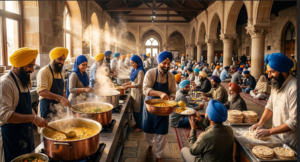
At Kartarpur, Nanak founded the ideal egalitarian commonwealth: combining honest agricultural labor (Kirat Karo), daily communal singing of divine hymns (Naam Japna), and shared free meals in the community kitchen (Langar). Academic publications by Princeton University Press emphasize that Guru Nanak\’s Kartarpur community represents one of the earliest working utopian democracies founded on absolute racial, caste, and gender equality.
6. Scholarly References & Primary Historical Documents
- McLeod, W. H. (1968). Guru Nanak and the Sikh Religion. Oxford: Oxford University Press.
- Grewal, J. S. (1998). The Sikhs of the Punjab. Cambridge: Cambridge University Press.
- Singh, N. G. K. (1993). The Feminine Principle in the Sikh Vision of the Transcendent. Cambridge: Cambridge University Press.
- Cole, W. O., & Sambhi, P. S. (1995). The Sikhs: Their Religious Beliefs and Practices. Sussex Academic Press.