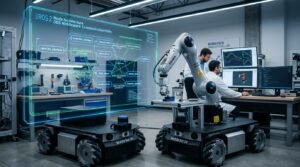
Strategic Intelligence Briefing: Humanoid Robotics VLA Models Sim2Real
General-purpose robotics has moved beyond rigid hard-coded factory arms into end-to-end Vision-Language-Action (VLA) foundation models. By pairing GPU-parallelized physics simulation (Sim2Real) with high-torque quasi-direct-drive actuators and tactile fingertips, humanoid platforms are entering live automotive and logistics workflows.
How Vision-Language-Action (VLA) Models Unify Perception and Control
Traditional robotics separated vision segmentation, inverse kinematics, and motion planning into brittle sequential modules. VLA policies map RGB-D camera streams and natural-language instructions directly to continuous joint-action tokens, enabling zero-shot generalization across novel tool placements and deformable objects.

Closing the Sim2Real Gap via Domain Randomization
Because real-world teleoperation data is expensive to collect, teams train reinforcement learning locomotion and manipulation policies across thousands of parallel simulated environments simultaneously—randomizing friction, lighting, payload mass, and sensor latency so policies transfer reliably to physical hardware.
Key Takeaways & Actionable Insights (Humanoid Robotics VLA Models Sim2Real)
Readers and practitioners evaluating this shift should anchor decisions around three verified operational coordinates:
- System 2 / System 1 Split: Slow VLM reasoning at 5–10Hz plans task sub-goals while fast visuomotor policies execute at 50–200Hz.
- Whole-Body Loco-Manipulation: Synchronizing leg balance with bimanual arm force control allows heavy bin picking.
- Tactile Force Feedback: Optical and piezoresistive fingertip arrays prevent crushing fragile components.
Comparative Benchmark Matrix
| Control Layer | Update Frequency | Primary Hardware / Model | Key Engineering Challenge |
|---|---|---|---|
| Task Reasoning (VLM) | 2 – 10 Hz | Multimodal Transformer | Latency & hallucination in edge cases |
| Visuomotor Policy (VLA) | 50 – 100 Hz | Diffusion / Action Chunking | Generalization to unseen lighting/clutter |
| Joint Torque Servo | 1,000 Hz+ | BLDC + Field-Oriented Control | Thermal dissipation & gear backlash |