
Islam (Shia) • Official Minbar • Ithna Ashari
Duration: 28:41
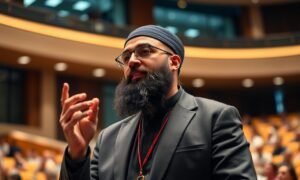
Executive Briefing: Dars Deen Shanasi PART 1 | Tawheed | Maulana Syed Ali Raza Rizvi
In this foundational lecture from his celebrated series Dars Deen Shanasi (Understanding Religion), internationally distinguished philosopher-orator Allama Syed Ali Raza Rizvi delivers a rigorous metaphysical exposition on Tawheed (The Divine Oneness of Allah). Transcending simplistic catechism, Allama Rizvi grounds the doctrine of monotheism in the linguistic precision of the Holy Quran and the sublime philosophical discourses of Imam Ali ibn Abi Talib (A.S) in Nahj-ul-Balagha. He systematically dismantles anthropomorphic misconceptions (Tashbeeh) and philosophical agnosticism, demonstrating that true Tawheed is the recognition of an uncaused, infinite, indivisible Creator whose essence is identical to His attributes. Below, Sapiotic documents the verbatim spoken discourse, authentic Arabic scriptural proofs, comparative theological classifications, common ideological pitfalls, a full timestamp reference guide, and an authoritative FAQ companion.
Watch the complete, high-definition lecture above by Allama Syed Ali Raza Rizvi while studying the verbatim spoken transcript and scholarly commentary below.
1. Video Transcription: Step-by-Step Spoken Analysis & Scriptural Citations by Allama Syed Ali Raza Rizvi
In this masterclass (“Dars Deen Shanasi: Tawheed”), Allama Syed Ali Raza Rizvi explores the intellectual architecture of faith. He explains why intellectual conviction (Ma’rifat) precedes blind imitation (Taqleed) in Islamic theology. Below is the step-by-step documentation of his spoken arguments, citations, and analytical reflections:
A. The Imperative of Ma’rifat: Usool-e-Deen Requires Intellectual Certainty
Spoken Discourse in Video: Allama Syed Ali Raza Rizvi opens with a vital theological principle: in the foundational roots of faith (Usool-e-Deen), blind imitation (Taqleed) is strictly forbidden. A believer cannot say ‘I believe in Allah because my parents or community believe.’ Every soul is intellectually mandated to acquire personal conviction (Yaqeen) through rational contemplation (Aql). Allama articulates: “Deen shuru hota hai Ma’rifat se. Agar bunyad aql par na ho, to thodi si azeeyat ya shakk pura imaan dhaa deta hai.”
أَوَّلُ الدِّينِ مَعْرِفَتُهُ، وَكَمَالُ تَوْحِيدِهِ الْإِخْلَاصُ لَهُ، وَكَمَالُ الْإِخْلَاصِ لَهُ نَفْيُ الصِّفَاتِ عَنْهُ
Sapiotic Theological Insight: Citing the opening sermon of Nahj-ul-Balagha, Allama stresses that religion begins with recognizing God, and perfection of recognition is sincere affirmation.
B. Tawheed-e-Zaat: The Indivisible Essence Free from Composition
Spoken Discourse in Video: Allama dismantles the human tendency to conceptualize God through physical metaphors. Allah is not composed of parts, nor bounded by dimensions, time, or spatial coordinates. If God possessed parts, He would depend upon those components to exist, and any dependent entity cannot be an absolute Creator (Wajib-ul-Wujood). He recites: “Subhanallah ka matlab sirf tasbeeh padhna nahi hai—is ka matlab hai Rab ko har nuqs, har hadd, aur har insani tasawwur se paak janna.”
كَمَالُ تَوْحِيدِهِ الْإِخْلَاصُ لَهُ، وَكَمَالُ الْإِخْلَاصِ لَهُ نَفْيُ الصِّفَاتِ عَنْهُ
Sapiotic Theological Insight: Absolute Tawheed necessitates negating external, created attributes from the Divine Essence; His knowledge, power, and life are identical to His being.
C. Tawheed-e-Sifaat vs. Anthropomorphism (Tashbeeh)
Spoken Discourse in Video: Allama addresses historical deviations where sects attributed hands, a physical face, or descending movements to God. He emphasizes the definitive Quranic axiom in Surah Ash-Shura (42:11): “لَيْسَ كَمِثْلِهِ شَيْءٌ” (Laysa kamithlihi shay’ — There is nothing like unto Him). Allama explains that metaphoric terms in the Quran like Yadullah (Hand of Allah) refer to divine power and authority, not physical limbs. Attributing physicality reduces God to a creature within the matrix of creation.
لَيْسَ كَمِثْلِهِ شَيْءٌ ۖ وَهُوَ السَّمِيعُ الْبَصِيرُ
Sapiotic Theological Insight: Rejection of anthropomorphism (Nafy al-Jism) preserves divine transcendence without falling into total agnosticism (Ta’teel).
D. Tawheed-e-Af’aal: The Sovereignty of Divine Governance
Spoken Discourse in Video: Moving from abstract ontology to existential reality, Allama explains Tawheed in action. Every breath, heartbeat, and cosmic orbit operates under Divine will. Believers who obsess over worldly patrons while neglecting the ultimate Sustainer suffer from subtle polytheism (Shirk-e-Khafi). He delivers an urgent reminder: “Rizq dene wala sirf aur sirf Rab hai. Makhlooq sirf zariya ban sakti hai, khaliq nahi.”
قُلِ اللَّهُ خَالِقُ كُلِّ شَيْءٍ وَهُوَ الْوَاحِدُ الْقَهَّارُ
Sapiotic Theological Insight: Recognizing Allah as the sole independent actor liberates the human soul from servility to tyrant regimes and economic anxiety.
2. Sapiotic Scholarly Analysis: The Jurisprudence & Philosophy of Tawheed in Shia Kalam
A. The Four Dimensions of Tawheed According to Classical Ithna Ashari Theologians
In the theological heritage of the Ahlulbayt (A.S) as codified by Shaykh al-Saduq (Kitab al-Tawheed) and Allama al-Hilli (Kashf al-Murad), monotheism is structured across four interrelated tiers:
| Dimension | Classical Definition | Correlative Deviation | Scriptural / Theological Proof |
|---|---|---|---|
| Tawheed-e-Zaat | Allah is One, absolute, without partner (Sharik) or internal composition (Tarkib). | Dualism (Thanawiyyah) / Polytheism (Shirk) | Surah Al-Ikhlas (112:1-4): ‘Say, He is Allah, [who is] One.’ |
| Tawheed-e-Sifaat | Divine attributes (Knowledge, Power) are identical to His Essence, not distinct entities. | Tashbeeh (Anthropomorphism) & Multiplicity | Nahj-ul-Balagha, Sermon 1: ‘Perfection of sincerity is to negate distinct attributes.’ |
| Tawheed-e-Af’aal | No independent agent exists in the cosmos; all causality derives from Allah. | Jabr (Absolute Fatalism) vs. Tafweed (Absolute Independence) | Imam Sadiq (A.S): ‘Neither absolute predestination nor delegation, but a matter between the two.’ |
| Tawheed-e-Ibadat | Worship and unconditional obedience belong exclusively to the Creator. | Shirk in worship & veneration of temporal tyrants | Surah Al-Fatiha (1:5): ‘You alone we worship, and You alone we ask for help.’ |
B. The Philosophical Harmony of Reason (Aql) and Revelation (Naql)
A signature contribution of Allama Syed Ali Raza Rizvi’s discourse is demonstrating that authentic Quranic theology never contradicts sound reason. While revelation discloses metaphysical truths beyond empirical observation, it never demands belief in logical impossibilities. The concept of an uncaused First Cause (Wajib-ul-Wujood) satisfies the intellect’s search for existential coherence, serving as an unshakeable antidote to modern secular skepticism.
3. Common Spiritual Mistakes & Legal Pitfalls Highlighted by Allama Syed Ali Raza Rizvi
In this address, Allama Syed Ali Raza Rizvi warns the community against critical oversights and theological misconceptions:
-
Relying on Blind Imitation (Taqleed) in Beliefs:
Juristic consensus across Shia Islam decrees that Taqleed is impermissible in Usool-e-Deen. Every individual must possess reasoned conviction regarding Tawheed, Adl, Nubuwwat, Imamat, and Qiyamat. -
Literalist Anthropomorphism (Tashbeeh):
Interpreting allegorical Quranic phrases (such as the ‘Face’ or ‘Throne’ of Allah) as anatomical limbs violates the foundational axiom of divine transcendence. -
Subtle Polytheism (Shirk-e-Khafi) in Daily Anxiety:
Believing that human bosses, wealth, or political connections possess independent power to sustain or ruin an individual eclipses trust in the ultimate Provider (Ar-Razzaq). -
Confusing Tawassul with Intermediary Worship:
Seeking the intercession of the Holy Prophet ﷺ and the Ahlulbayt (A.S) is valid because they are humble servants of Allah whose prayers are honored, never independent divine partners.
4. Video Timestamp Reference Guide (iwMH3RqpwPs)
Use this chronological reference index to navigate directly to the specific explanations and demonstrations in Allama Syed Ali Raza Rizvi’s recorded lecture:
| Timestamp | Action in Video | Spoken Focus & Practical Instruction |
|---|---|---|
| 00:00 – 04:30 | Opening Discourse & Theological Foundations | Why Usool-e-Deen demands intellectual research rather than passive tradition. |
| 04:31 – 10:15 | The Concept of Wajib-ul-Wujood (The Necessary Being) | Philosophical proof of an uncaused Cause and the impossibility of infinite regress. |
| 10:16 – 16:45 | Tawheed-e-Zaat and the Negation of Physical Limits | Exegesis of Surah Al-Ikhlas and why divine composition leads to dependency. |
| 16:46 – 22:30 | Nahj-ul-Balagha Sermon 1 Breakdown | Imam Ali’s exposition on the perfection of Ma’rifat and negation of created attributes. |
| 22:31 – 28:41 | Practical Dimensions of Monotheism & Conclusion | Transforming abstract theology into psychological resilience, humility, and moral integrity. |
5. Frequently Asked Questions (FAQ)
Authoritative clarifications addressing the most common inquiries regarding this lecture:
Why is Taqleed (following a Mujtahid) forbidden in Tawheed and Usool-e-Deen?
According to universal Ja’fari jurisprudence, Taqleed is restricted exclusively to Furoo-e-Deen (practical rulings such as prayer, fasting, and commercial transactions). In core beliefs (Usool-e-Deen), every human being must acquire personal rational certainty, as faith cannot be outsourced to another person.
How does Shia Kalam resolve the problem of allegorical Quranic verses?
Under the hermeneutics taught by the Ahlulbayt (A.S), ambiguous verses (Mutashabihat) are interpreted in light of unequivocal foundational verses (Muhkamat). Therefore, verses mentioning ‘Hand’ or ‘Eye’ are understood through the lens of ‘Laysa kamithlihi shay’ (There is nothing like Him) as signifying Divine Power and Divine Oversight.
What is the difference between Tawheed-e-Zaat and Tawheed-e-Sifaat?
Tawheed-e-Zaat means that God is single in His essence and possesses no internal divinions or partners. Tawheed-e-Sifaat means that His attributes (such as Infinite Knowledge and Absolute Power) are not distinct from His Being; rather, His Essence is pure knowledge, pure power, and pure existence.
Related Publications & Curriculum Pillars


Related Research & Authoritative Analyses
- › Khutbat-e-Haram: Tawheed, Wahdat-e-Ummat Aur Quran Ki Talimat: Sheikh Al-Sudais
- › The Architecture of Tauba and Divine Mercy: Maulana Tariq Jamil on Spiritual Renewal
- › Sufism and The Path of Divine Love: Complete Definitive Guide & Analysis (2026)
- › Islam Aur Asr-e-Hazir: Fikr-e-Farahi Aur Quranic Hermeneutics: Javed Ahmad Ghamidi