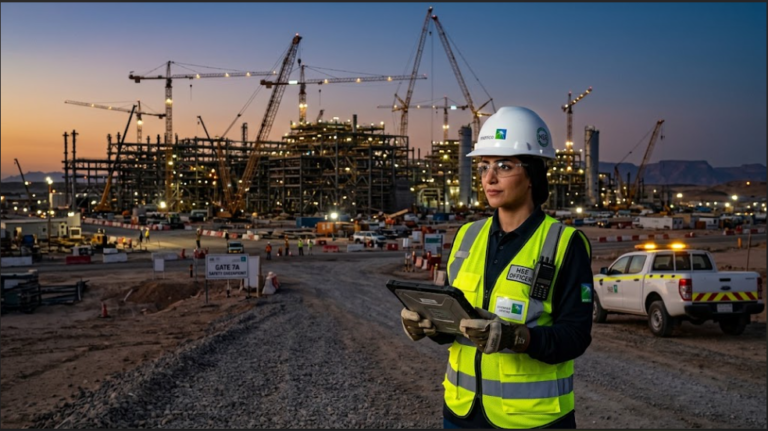
A site safety audit is only as effective as the daily inspection routine behind it. For HSE Officers, Site Safety Inspectors, and EHS Managers, following a structured daily inspection checklist ensures zero regulatory violations, prevents catastrophic downtime, and enforces zero-harm culture on industrial and construction worksites.
Table of Contents
The Safety Officer Inspection Checklist establishes an essential operational standard and analytical framework for modern organizations in 2026.
Core Sections of the Daily Safety Inspection
This checklist follows international standards under OSHA 1926/1910, NEBOSH General Certificate guidelines, and ISO 45001:2018. Use these 7 critical inspection modules during your morning site walk-through.
Module 1: Mandatory PPE & Worker Readiness
- Are all workers wearing approved 4-point chin-strap safety helmets (ANSI Z89.1 / EN 397)?
- Are impact-resistant safety glasses or face shields worn during grinding, drilling, or chipping?
- Are steel-toe safety shoes (EN ISO 20345 / ASTM F2413) clean and undamaged?
- Are high-visibility safety vests with reflective strips visible from all angles?
- Is task-specific PPE deployed (welding leather aprons, chemical-resistant nitrile gloves, ear defenders for noise > 85 dBA)?
Module 2: Scaffolding and Working at Heights
- Tagging Verification: Is there a valid GREEN Scafftag signed by a certified scaffolding inspector within the past 7 days? (If altered or defective, is a RED Tag prominently displayed?)
- Base Plates & Sole Boards: Are base plates resting securely on sound sole boards with no soil settlement?
- Guardrail Systems: Are top rails (approx. 42 inches / 105 cm) and intermediate mid-rails installed on all open sides?
- Toe Boards: Are 15 cm (6 inch) toe boards installed to prevent tools or debris from falling?
- Full Body Harnesses: Are workers anchored to certified anchor points or static lifelines via double lanyards with shock absorbers?
Module 3: Temporary Electrical Installations
- Are all distribution boards (DBs) fitted with functional ELCB / RCD (Residual Current Devices) tested at 30mA trip threshold?
- Are electrical cables elevated above ground level using insulated S-hooks rather than running across wet ground or vehicle pathways?
- Are industrial plug and socket couplers (CEE-form) water-resistant (IP44 / IP67) with no exposed, taped joints?
- Is all portable electrical power equipment (grinders, drills) verified via a monthly color-coded inspection tag?
Module 4: Hot Work & Fire Prevention
- Is an authorized Hot Work Permit posted clearly at the workstation?
- Is a 10-meter (35-foot) radius cleared of all combustible waste, wood shavings, and flammable liquids?
- Are certified fire blankets or fire-retardant screens erected to contain sparks and slag?
- Are dual dry chemical powder (DCP) or CO2 fire extinguishers immediately accessible within 5 meters?
- Is a designated Fire Watch assigned with an air horn, remaining on post for at least 30 to 60 minutes after hot work completes?
Module 5: Excavation and Trenching
- Has an excavation permit been endorsed with underground service clearance (GPR & cable locator report)?
- For trenches deeper than 1.2 meters (4 feet), are protective measures in place (sloping, benching, or trench shoring)?
- Are access ladders positioned within 7.5 meters (25 feet) of lateral travel for workers?
- Is excavated spoil material kept at least 1 meter (3 feet) back from the edge of the trench?
- Are rigid barricades and night warning blinkers installed around all open trenches?
Module 6: Lifting Equipment & Rigging Operations
- Are the crane, boom truck, or hoist accompanied by a valid Third-Party Inspection (TPI) certificate?
- Is the crane operator and rigger certified and carrying authorized operator licenses?
- Are outriggers fully extended on timber mats (cribbing)?
- Are rigging slings (webbing, wire rope) free from fraying, cuts, kinks, or chemical damage, displaying legible Safe Working Load (SWL) tags?
- Is the entire swing radius barricaded with taglines used on all suspended loads?
Module 7: Housekeeping & Chemical Storage (COSHH)
- Are emergency egress routes, corridors, and stairs clear of tools, materials, and debris?
- Are chemicals and fuel canisters stored on secondary containment spill pallets with 110% capacity?
- Are Safety Data Sheets (SDS / MSDS) displayed in local languages near chemical storage areas?
- Are designated eyewash stations verified functional with clean water?
Daily Safety Officer Inspection Checklist Matrix
| Inspection Item | Frequency | Key Compliance Verification | Action If Deficient |
|---|---|---|---|
| Scaffolding Structure | Daily walk + 7-Day tag | Green Scafftag signed, guardrails, toe boards | Flip to RED tag; stop work until rectified |
| Electrical Tools | Daily visual check | Monthly color-code tag, double insulated, no bare wires | Confiscate to quarantine storage for repair |
| Hot Work Perimeter | Per shift / continuous | Fire blanket, 2x extinguishers, dedicated fire watch | Revoke Hot Work Permit until zone is cleared |
| Excavation Shoring | Daily morning & after rain | No soil cracks, spoil pile setback > 1m, ladder access | Evacuate trench; re-engineer shoring slope |
| Lifting Rigging Slings | Pre-lift check | SWL capacity tag, no cuts, safety latch on crane hook | Destroy cut web slings immediately to prevent reuse |
Post-Inspection SOP: The Corrective Action Protocol
Documenting a hazard is only step one. An effective Safety Officer enforces close-out:
- Class A Hazard (Imminent Danger): Issue immediate verbal Stop Work. Remain at location until area is secured. Log an Urgent NCR (Non-Conformance Report).
- Class B Hazard (Moderate Risk): Issue a Corrective Action Request (CAR) with a strict 24-hour rectification deadline to the sub-contractor foreman.
- Class C Hazard (Minor Housekeeping): Direct immediate on-site cleanup during your walk-through and record in the daily HSE logbook.
For verified regulatory standards and institutional research, consult the International Organization for Standardization (ISO) guidelines.
Explore interconnected research and benchmarks in our analysis of Commercial Real Estate Underwriting 2026.
🔥 Related High-Demand Job Openings
Explore verified employment vacancies across the UAE, Saudi Arabia, and International projects: