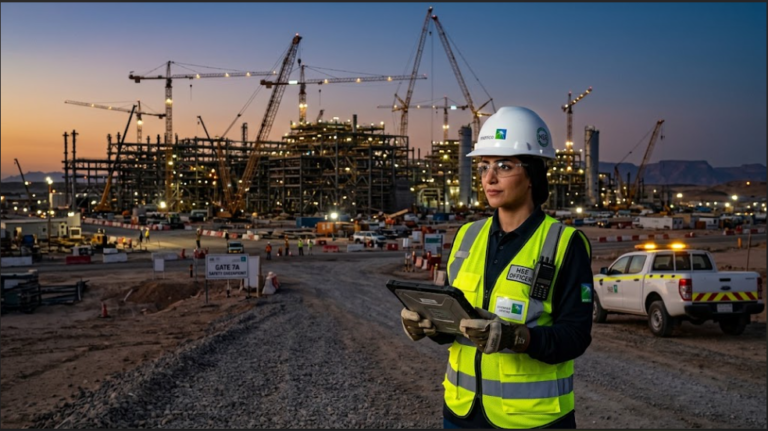
Landing an approved Safety Officer role on Saudi Aramco mega-projects, NEOM (The Line, Oxagon, Trojena), or Red Sea Global is the primary career goal for thousands of HSE professionals across Asia, the Middle East, and Africa. With tax-free salaries ranging from 12,000 to 25,000+ SAR ($3,200 – $6,700 USD) plus full accommodation and rotation benefits, Aramco and NEOM approval commands the highest prestige in the global construction and energy sector.
Table of Contents
The Aramco Safety Officer Approval establishes an essential operational standard and analytical framework for modern organizations in 2026.
How Do You Get Aramco/NEOM Approved as a Safety Officer?
To achieve official Saudi Aramco approval (SAPO) in 2026, candidates must fulfill three mandatory phases: 1) Document Pre-Qualification: A verified engineering/science diploma + NEBOSH IGC + minimum 5 years verified field experience. 2) Aramco CBT (Computer-Based Test): A Pearson VUE administered examination covering Aramco Construction Safety Manual (CSM) standards. 3) Proponent Interview: A technical evaluation by Aramco Safety Division (Loss Prevention Department) inspecting your hazard mitigation, PTW mastery, and leadership authority.
1. Mandatory Minimum Qualifications (Aramco & NEOM Benchmarks)
Unlike standard sub-contractor roles, Aramco and NEOM Project Management Teams (SAPMT) enforce strict non-negotiable credential thresholds:
- Academic Education: Minimum 3-Year Technical Diploma in Engineering / Science or a recognized Bachelor’s Degree. High school matriculation alone is no longer approved for SAPO status.
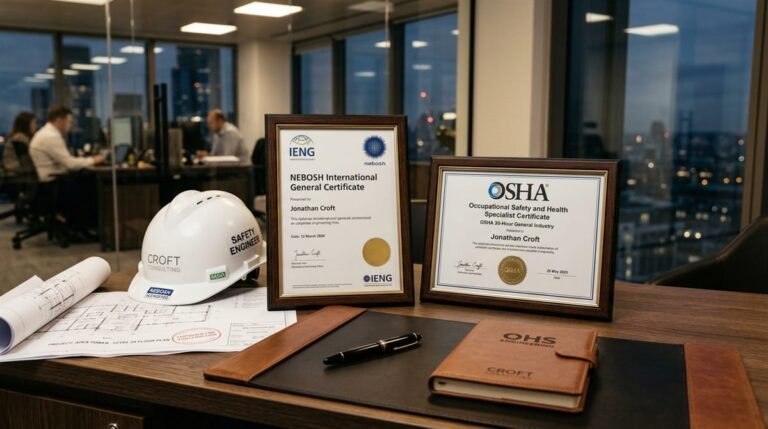
- Mandatory Certification: NEBOSH IGC (International General Certificate) with verified Scottish Qualifications Authority (SQA) certificate numbers.
- Verified Experience: Minimum 5 years documented industrial safety experience (at least 2 years in heavy industrial construction, petrochemical, or refinery environments).
- Secondary Certifications: Valid OSHA 30-Hour card, IOSH Managing Safely, First Aid at Work (BLS), and basic Fire Warden training.
- Aramco Specific Courses (Post-Hire): Work Permit Receiver (WPR) certification, Confined Space Entry Supervisor, and Hazard Identification & Testing.
2. The Aramco CBT Examination: Structure & Passing Strategy
The Saudi Aramco Computer-Based Test (CBT) is delivered internationally through authorized Pearson VUE testing centers. The test consists of 80 to 100 multiple-choice questions with an 80% minimum passing score. The syllabus is taken directly from the Saudi Aramco Construction Safety Manual (CSM):
| CSM Topic Section | Primary Focus Points | Weightage |
|---|---|---|
| Permit to Work (PTW) System | Hot work, cold work, confined space, entry attendant duties, joint site inspections | 25% |
| Scaffolding & Working at Heights | Scaffolding tagging, planking, tie-ins, mobile towers, full-body harness anchorage | 20% |
| Excavation & Trenching | Soil classifications (A, B, C), shoring angles, spoil pile setbacks (1 meter minimum), ladder spacing | 15% |
| Heavy Equipment & Rigging | Critical lift plans (>40 tons or near live lines), crane outrigger pads, sling inspections | 15% |
| Hazardous Substances & Confined Space | H2S gas hazards, LEL limits, atmospheric testing sequence, continuous ventilation | 15% |
| Electrical Safety & LOTO | GFCI / RCD 30mA protection, lockout/tagout sequence, temporary power distribution | 10% |
3. Top Technical Questions Asked in the Aramco Proponent Interview
Q1: Under Aramco CSM, when is an excavation considered a Confined Space?
Answer: Any excavation or trench with a depth of 1.2 meters (4 feet) or greater where hazardous atmospheric conditions (such as oxygen deficiency, accumulation of toxic gases like H2S, or flammable vapors) could reasonably exist is classified as a confined space requiring an authorized Confined Space Entry Permit and gas testing.
Q2: What defines a “Critical Lift” under Saudi Aramco standards?
Answer: Under Aramco Safety Management System (SMS), a lift is classified as Critical if any of the following apply:
- The load exceeds 40 metric tons.
- The load reaches 85% or greater of the crane’s rated capacity.
- Tandem or multiple crane lifts.
- Lifting over operating hydrocarbon lines, pressurized pipes, or energized high-voltage power lines.
- Lifting personnel using an approved crane man-basket.
Q3: What are the toxic thresholds for Hydrogen Sulfide (H2S)?
Answer: Under Aramco standards: 10 ppm is the maximum permissible 8-hour Time-Weighted Average (TWA) and the threshold where audible/visual alarms must activate. At 100 ppm, the concentration is classified as Immediately Dangerous to Life or Health (IDLH), causing rapid loss of consciousness and olfactory fatigue.
4. NEOM Approval Differences: Sustainability & Welfare
While NEOM honors Aramco and OSHA technical standards, NEOM project authorities place unprecedented scrutiny on two supplementary areas during approval interviews:
- Worker Welfare & Heat Stress: Strict compliance with the Saudi Ministry of Human Resources mid-day work ban (12:00 PM to 3:00 PM during summer months) and continuous thermal work limit (TWL) index monitoring.
- Environmental Protection & Waste Diversion: Strict zero-spill soil compliance, hazardous wastewater treatment, and zero unauthorized desert footprint encroachment.
For verified regulatory standards and institutional research, consult the International Organization for Standardization (ISO) guidelines.
Explore interconnected research and benchmarks in our analysis of Commercial Real Estate Underwriting 2026.
🔥 Related High-Demand Job Openings
Explore verified employment vacancies across the UAE, Saudi Arabia, and International projects: