Amid escalating state-sponsored hybrid warfare and sophisticated ransomware syndicates targeting British banking, nuclear energy, and telecommunications infrastructure, recruitment for Cybersecurity Threat Intelligence & Critical National Infrastructure (CNI) Defense Directors in London has reached unprecedented urgency in 2026. Commanding executive compensation packages spanning £140,000 to over £220,000+, these strategic leaders align corporate security architectures with National Cyber Security Centre (NCSC) standards, implement deterministic Zero-Trust microsegmentation, and direct rapid incident responses against advanced persistent threats (APTs).
1. The 2026 UK Cyber Threat Landscape
The UK government’s statutory Cyber Security and Resilience Bill has placed legal liability directly upon board-level executives to safeguard essential national services. In 2026, cybersecurity is no longer relegated to back-office IT departments; it represents a primary vector of corporate governance. Defense directors must protect heterogeneous environments combining legacy SCADA/ICS industrial control systems with public cloud multi-tenant architectures against sophisticated AI-generated spear-phishing, supply chain firmware compromises, and quantum-decryptable cipher breaches.
Critical Governance & Technical Mandates
- NCSC Cyber Assessment Framework (CAF 3.2): Enforcing comprehensive security outcomes across Identity & Access Control, Data Security, Resilient Networks, and Incident Management.
- Zero-Trust Architecture (ZTA): Eliminating implicit network perimeter trust through continuous contextual authentication, ephemeral credentials, and strict microsegmentation.
- Threat Intelligence & MITRE ATT&CK Mapping: Ingesting real-time adversary telemetry to proactively hunt for living-off-the-land (LotL) binaries and kernel-level rootkits.
2. Defensive Architecture: The Sovereign Cyber Operations Center
The operational framework linking real-time telemetry ingestion, AI anomaly correlation, and automated incident containment is illustrated below:
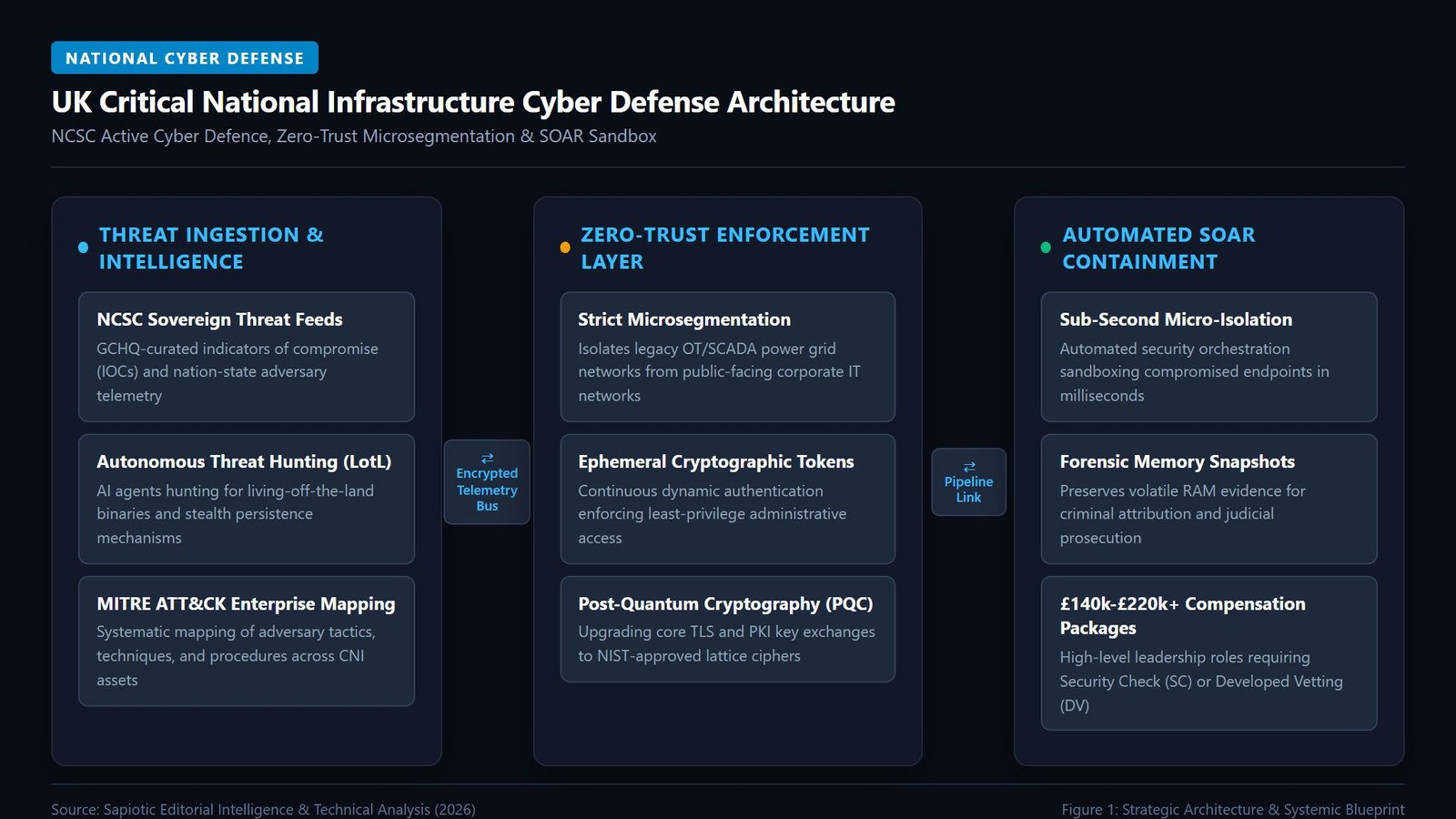
As visualized above, telemetry from endpoints, cloud workloads, and industrial telemetry nodes is processed through an automated SIEM/SOAR pipeline, correlating IOC indicators with NCSC Threat Feeds to execute micro-isolation within milliseconds of intrusion detection.
3. 2026 UK Compensation & Security Clearance Premiums
Remuneration for cybersecurity leadership in London reflects the extreme shortage of professionals holding both board-level advisory skills and active national security clearances:
| Executive Position | Base Salary (GBP) | Executive Bonus & Equity | Total Package (TC) | Clearance Requirement |
|---|---|---|---|---|
| Head of Cyber Threat Intelligence | £105,000 – £135,000 | £20,000 – £35,000 | £125,000 – £170,000 | Security Check (SC) |
| Director of CNI Cyber Defense | £135,000 – £175,000 | £35,000 – £60,000 | £170,000 – £235,000 | Developed Vetting (DV) |
| Chief Information Security Officer (CISO) | £175,000 – £240,000+ | £60,000 – £120,000+ | £235,000 – £360,000+ | DV / Commercial Top Tier |
4. Mandatory Accreditations & Professional Certifications
To lead security divisions for major financial institutions (HSBC, Barclays), critical energy grids (National Grid, EDF Energy), or defense primes (BAE Systems, QinetiQ), directors must demonstrate verifiable accreditations:
- Certified Information Systems Security Professional (CISSP) or CISM in good standing.
- Chartered Cyber Security Professional (ChCSP) status recognized by the UK Cyber Security Council.
- Active Developed Vetting (DV) or eligibility to undergo high-level UK national security vetting.
- Proven leadership directing crisis management tabletop exercises with the NCSC Incident Management Team.
Related Research & Authoritative Analyses
- › US Corporate Treasurer & Financial Manager Jobs 2027: $166k–$285k+ Liquidity & Cashflow Careers
- › India Capital Goods Boom: 50 Lakh Jobs in CNC Machining, PLC Automation & Industrial Robotics
- › US Private Equity & Quant Risk Jobs 2027: Base Pay, Carry, Bonuses & Automated Modeling
- › Gulf Healthcare Medical Consultant: DHA & SCFHS Licensing, Western Board Certification & $200k–$380k Tax-Free Guide 2026
🔥 Related High-Demand Job Openings
Explore verified employment vacancies across the UAE, Saudi Arabia, and International projects:


