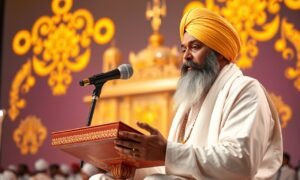
Gurmat Heritage Discourse: Bhai Sukha Singh Ji, a leading pracharak of the global Basics of Sikhi movement and esteemed Panthic historian, has revived Sikh historical consciousness and Gurmat scholarship for English-speaking youth worldwide. Through meticulously referenced historical narratives (Ithihas) and philosophical exposition of Sri Guru Granth Sahib Ji, his lectures synthesize warrior sovereignty with contemplative devotion.
1. The Doctrine of Miri-Piri: Harmonizing Temporal & Spiritual Sovereignty
Established by Sri Guru Hargobind Sahib Ji (the Sixth Guru), the dual swords of Miri (temporal authority) and Piri (spiritual leadership) represent the complete synthesis of human responsibility. Bhai Sukha Singh highlights that Sikhism decisively rejects passive ascetic withdrawal from the world: the true saint is also a warrior who defends the defenseless and establishes social justice.

2. The Living Guru: Epistemology of Shabad Guru
In Gurmat philosophy, the Guru is not a mortal human body, but the eternal Divine Word (Shabad). Sri Guru Gobind Singh Ji permanently bestowed temporal sovereignty upon the collective Khalsa Panth and spiritual sovereignty upon Sri Guru Granth Sahib Ji:
- Naam Simran (Contemplative Remembrance): Continuous internal alignment with the Divine Current that eliminates ego (Haumai).
- Kirat Karo (Honest Labor): Engaging in ethical, productive enterprise with zero reliance on exploitation or deceit.
- Vand Chhako (Selfless Sharing): Distributing wealth and running community kitchens (Langar) to dismantle caste and social hierarchies.
3. Historical Resilience: The Martyrdom Tradition & Sovereign Spirit
Bhai Sukha Singh’s historical discourses systematically chronicle the incredible endurance of the 18th-century Sikhs during brutal extermination campaigns under Mughal governors and Afghan invaders (Ahmad Shah Durrani). The unyielding spirit of Chardi Kala (eternal buoyant optimism) reveals that political persecution cannot extinguish a community whose identity is anchored in the Timeless Divine (Akal Purakh).
| Pillar of Gurmat | Spiritual Dimension (Piri) | Temporal Manifestation (Miri) |
|---|---|---|
| Identity | Ego-free surrender to Divine Hukam | Uncompromised Bana, Dastar & 5 Kakaars |
| Social Action | Universal brotherhood (Sarbat Da Bhala) | Active protection of the oppressed against tyranny |
| Daily Discipline | Amrit Vela Nitnem and Shabad immersion | Excellence in worldly vocation and service (Seva) |
Frequently Asked Questions (FAQ)
What is the core meaning of ‘Chardi Kala’ in Sikh philosophy?
Chardi Kala represents an unshakeable state of divine optimism, high spirits, and courage even in the face of insurmountable adversity, rooted in absolute faith in the Divine Will (Hukam).
How does the Guru Granth Sahib unite diverse spiritual traditions?
Sri Guru Granth Sahib Ji is universally unique among world scriptures because it includes not only the hymns of the Sikh Gurus, but also the compositions of 15 Bhagats and Sufi saints across diverse Hindu and Muslim backgrounds, celebrating the oneness of the Divine.
Related Publications & Curriculum Pillars


Related Research & Authoritative Analyses
- › The Primordial Purity & The Rainbow Body: Padmasambhava on Dzogchen, Trekchö & The Bardo Thödol 2027
- › The Spirit Born People & Cosmic Humanism: Prof. Puran Singh on the Mystical Ecstasy of Gurbani & Khalsa Sovereignty 2027
- › Mool Mantar Hermeneutics & Gurmat Gian: Giani Sant Singh Maskeen on Shabad Braham, Naam Simran & Divine Epistemology 2027
- › Guru Nanak Dev Ji: Mool Mantar Cosmology, Japji Sahib & The Three Pillars of Sikh Living 2027