Table of Contents: Bhagavad Gita Synthesis of Yogas
The philosophical masterwork of the Bhagavad Gita Synthesis of Yogas (composed around the second century BCE as an eighteen-chapter dialogue within the monumental Mahabharata) represents one of the most widely read and influential philosophical texts in human history. Set upon the terrifying brink of fratricidal war on the battlefield of Kurukshetra, the conversation between the despondent warrior-prince Arjuna and his divine charioteer Lord Krishna transcends its military setting, offering a universal synthesis of ethical action, intellectual discernment, and loving devotion.
1. The Crisis on Kurukshetra: Arjuna\’s Existential Collapse
As the war conches blow and millions of armored troops stand poised for slaughter, Prince Arjuna commands Krishna to drive his chariot into the neutral space between the two opposing armies. Looking across the front lines, Arjuna perceives beloved grandfathers, venerable teachers, brothers, and lifelong friends lined up on both sides.
Overcome by grief, moral paralysis, and pity, Arjuna drops his celestial bow (Gandiva), trembles violently, and collapses onto the chariot seat, declaring that he would rather wander as a penniless beggar than murder his kinsmen for an earthly kingdom drenched in blood. This dramatic paralysis is the universal crisis of human duty: what does one do when righteous duty appears to demand devastating violence? For deep inquiries into epic literature and comparative ethics, explore Sapiotic.
2. Karma Yoga: The Art of Desireless Action (*Nishkama Karma*)
Krishna responds not with superficial comfort, but by formulating the celebrated doctrine of Karma Yoga—the path of desireless, unattached action:
“Karmanye vadhikaraste ma phaleshu kadachana,
Ma karma-phala-hetur bhur ma te sango \’stv akarmani.”
— “You have a right only to perform your work, but never to its fruits.
Let not the fruits of action be your motive, nor let your attachment be to inaction.”
— Bhagavad Gita, Chapter 2, Verse 47
Krishna explains that human suffering and anxiety do not arise from action itself, but from psychological fixation on the outcome—greed for success or terror of failure. In Nishkama Karma, an individual acts with supreme dedication, excellence, and ethical integrity, yet surrenders all fruits of the labor to the Divine. Action becomes a selfless sacrifice (Yajna), transforming daily duty into meditation.
3. Jnana Yoga: Metaphysical Discrimination of the Eternal Self
To cure Arjuna\’s grief over the mortality of his loved ones, Krishna introduces Jnana Yoga (the path of knowledge), rooted in the immortality of the soul (Atman):
“Weapons cannot cleave it, fire cannot burn it, water cannot wet it, and wind cannot dry it. Just as a person casts off worn-out garments and puts on new ones, so the embodied soul casts off worn-out bodies and enters new ones.”
By discerning between the perishable physical biological shell (Prakriti) and the indestructible, eternal conscious witness (Purusha), the spiritual seeker rises above the terror of death and the sorrow of loss.
4. Bhakti Yoga: Loving Surrender and Divine Grace
While recognizing the validity of philosophical contemplation (Jnana) and disciplined duty (Karma), Krishna reveals that the most accessible and sublime path for ordinary human beings is Bhakti Yoga—unconditional, loving devotion to the personal Divine.
Krishna assures Arjuna that devotion requires no wealthy offerings, elite caste status, or complex rituals: “Whoever offers me with love even a single leaf, a flower, a fruit, or a cup of water, that offering of love I accept with joy.” In Chapter 18, Krishna concludes with the ultimate promise (Charama Shloka): “Abandon all varieties of dharmas and surrender unto Me alone; I shall liberate you from all sins; do not grieve.”
5. The Vishvarupa: The Terrifying Majesty of Cosmic Time
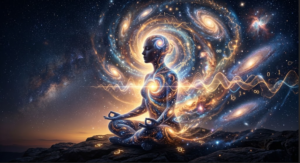
In Chapter 11, at Arjuna\’s request, Krishna grants him divine vision (Divya-Chakshu) to behold the Vishvarupa—the cosmic, universal form of God. Arjuna witnesses a blazing, infinite entity with thousands of arms, mouths, and burning eyes, spanning the galaxies.
Arjuna watches in terror as all the kings, warriors, and planets are swept like moths into the fiery, ravenous jaws of the cosmic giant, crushed to powder between razor-sharp teeth. Terrified, Arjuna cries: “Who are you in this terrible form?” Krishna utters the immortal words:
“Kalo \’smi loka-kshaya-krit pravriddho.”
— “I am Time, the great destroyer of the worlds, arisen to consume all beings.”
This vision demonstrates that change, death, and dissolution are inescapable cosmic realities. Arjuna cannot stop the war or save the bodies of his relatives; he can only fulfill his role as a righteous instrument (Nimitta-matram) in the cosmic play of time. Academic presses including Oxford University Press celebrate the Gita as one of the most sublime philosophical masterworks ever created.
6. Scholarly References & Critical Commentaries
- Minor, R. N. (1986). Modern Indian Interpreters of the Bhagavadgita. Albany: State University of New York Press.
- Radhakrishnan, S. (1948). The Bhagavadgītā: With an Introductory Essay, Sanskrit Text, English Translation and Notes. London: George Allen & Unwin.
- Miller, B. S. (1986). The Bhagavad-Gita: Krishna\’s Counsel in Time of War. New York: Bantam Books.
- Sargeant, W. (1994). The Bhagavad Gita. Albany: State University of New York Press.