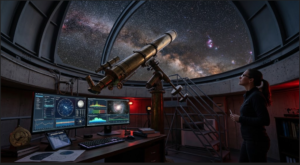
Executive Briefing: The Celestial Teapot Analogy
In 1952, philosopher Bertrand Russell formulated one of the most celebrated epistemological thought experiments in modern philosophy: the Celestial Teapot. It decisively illustrates that the burden of proof rests unconditionally upon the individual advancing an extraordinary, unfalsifiable claim, rather than upon the skeptic to disprove it.
Table of Contents
The philosophical principle of the Bertrand Russell Celestial Teapot provides an indispensable epistemological tool for distinguishing genuine empirical hypotheses from unfalsifiable metaphysical dogma.
Bertrand Russell Celestial Teapot: The 1952 Thought Experiment
In an unpublished article commissioned by Illustrated magazine titled “Is There a God?”, Russell wrote:
“If I were to suggest that between the Earth and Mars there is a china teapot revolving about the sun in an elliptical orbit, but that the teapot is too small to be revealed even by our most powerful telescopes, nobody would be able to disprove my assertion. But if I were to go on to say that, since my assertion cannot be disproved, it is intolerable presumption on the part of human reason to doubt it, I should rightly be thought to be talking nonsense.”
Russell noted that if the existence of such a teapot were affirmed in ancient books, taught as sacred truth every Sunday, and instilled into the minds of children at school, hesitation to believe in its existence would become a mark of eccentricity, entitling the skeptic to the attentions of the psychiatrist in an enlightened age, or of the Inquisitor in an earlier one.
Epistemological Mechanics: The Burden of Proof (Onus Probandi)
The fundamental logical foundation demonstrated by Russell is the classic legal and philosophical rule of onus probandi: the burden of proof rests entirely on the party making the affirmative claim.
It is logically impossible to prove a universal negative about an unfalsifiable entity. If a believer claims that a divine being exists outside time, space, and physical matter, demanding that the skeptic “disprove” this claim commits the logical fallacy of argumentum ad ignorantiam (appeal to ignorance). The absence of disproof does not constitute evidence of reality.
Karl Popper & Falsifiability: Why Unfalsifiable Claims Lack Epistemic Worth
Russell’s teapot directly parallels Karl Popper’s criterion of demarcation: for a proposition to be considered scientifically meaningful, it must be capable of being proven false by empirical observation. When claims are immunised against any conceivable empirical test, they cease to convey factual information about the cosmos.
Scientific Rationalism in the Era of Algorithmic Claims
In contemporary epistemic discourse, Russell’s teapot is essential for evaluating wild technological and socio-political assertions. Whether evaluating claims of synthetic media authenticity, esoteric conspiracy theories, or ungrounded machine consciousness, rigorous rationalism mandates: extraordinary claims require extraordinary evidence, and claims asserted without evidence can be dismissed without evidence (Hitchens’s Razor).
Frequently Asked Questions
Did Russell consider himself an atheist or agnostic?
Russell explained that while speaking to a purely philosophical audience, he labeled himself an agnostic because he could not deductively disprove God; however, speaking to the general public, he considered himself an atheist, in the exact same sense that he was an atheist regarding the Greek Olympian gods or the orbiting teapot.
Can religious philosophers defend against Russell’s teapot?
Some Christian philosophers (such as Alvin Plantinga) argue that unlike a teapot (which is a physical object with no prior probability in orbit), God is an ontological explanation for the existence of the universe. However, naturalists respond that this merely substitutes an unexplained physical mystery with a far more complex, ungrounded metaphysical mystery.
For canonical philosophical archives, consult the Stanford Encyclopedia of Philosophy: Bertrand Russell.
Explore Christian epistemology in our guide on Alvin Plantinga & Reformed Epistemology.