As enterprise technology organizations transition from initial generative AI prototyping into multi-million-parameter production deployments, the Senior AI & Machine Learning Systems Architect has emerged as the most mission-critical engineering hire in the United States. With total compensation packages spanning $280,000 to over $450,000, this role bridges deep neural network architecture with large-scale distributed systems, high-throughput memory hierarchies, and multi-node GPU cluster orchestration.
1. The 2026 Paradigm Shift: From Training to Production Inference Scaling
Throughout 2024 and 2025, capital expenditure was dominated by pre-training cluster acquisition. In 2026, the operational bottleneck has shifted aggressively toward inference efficiency, test-time compute routing, and tail-latency minimization. Today’s AI Systems Architects are evaluated not merely on algorithmic knowledge, but on their ability to slash cost-per-token by 70% while guaranteeing sub-15ms time-to-first-token (TTFT) across geographically distributed user bases.
Key Architectural Priorities in 2026
- PagedAttention & Dynamic Memory Management: Eliminating internal KV-cache fragmentation to maximize concurrent request concurrency in high-throughput engines like vLLM and TensorRT-LLM.
- Speculative Decoding Pipelines: Coupling compact draft models (1B–3B parameters) with high-capacity verification backbones (70B+ parameters) to achieve 2.5x token generation speedups without loss of output fidelity.
- Mixture-of-Experts (MoE) Route Optimization: Engineering low-overhead token-to-expert dispatch mechanisms across multi-GPU nodes with minimal inter-socket communication penalties.
2. Technical Architecture: Distributed Serving vs. Training Clusters
Building high-availability machine learning infrastructure requires distinct hardware topologies depending on whether the cluster is provisioned for synchronous distributed pre-training (all-reduce intensive) or asynchronous low-latency inference serving. The architectural divergence is visualized below:
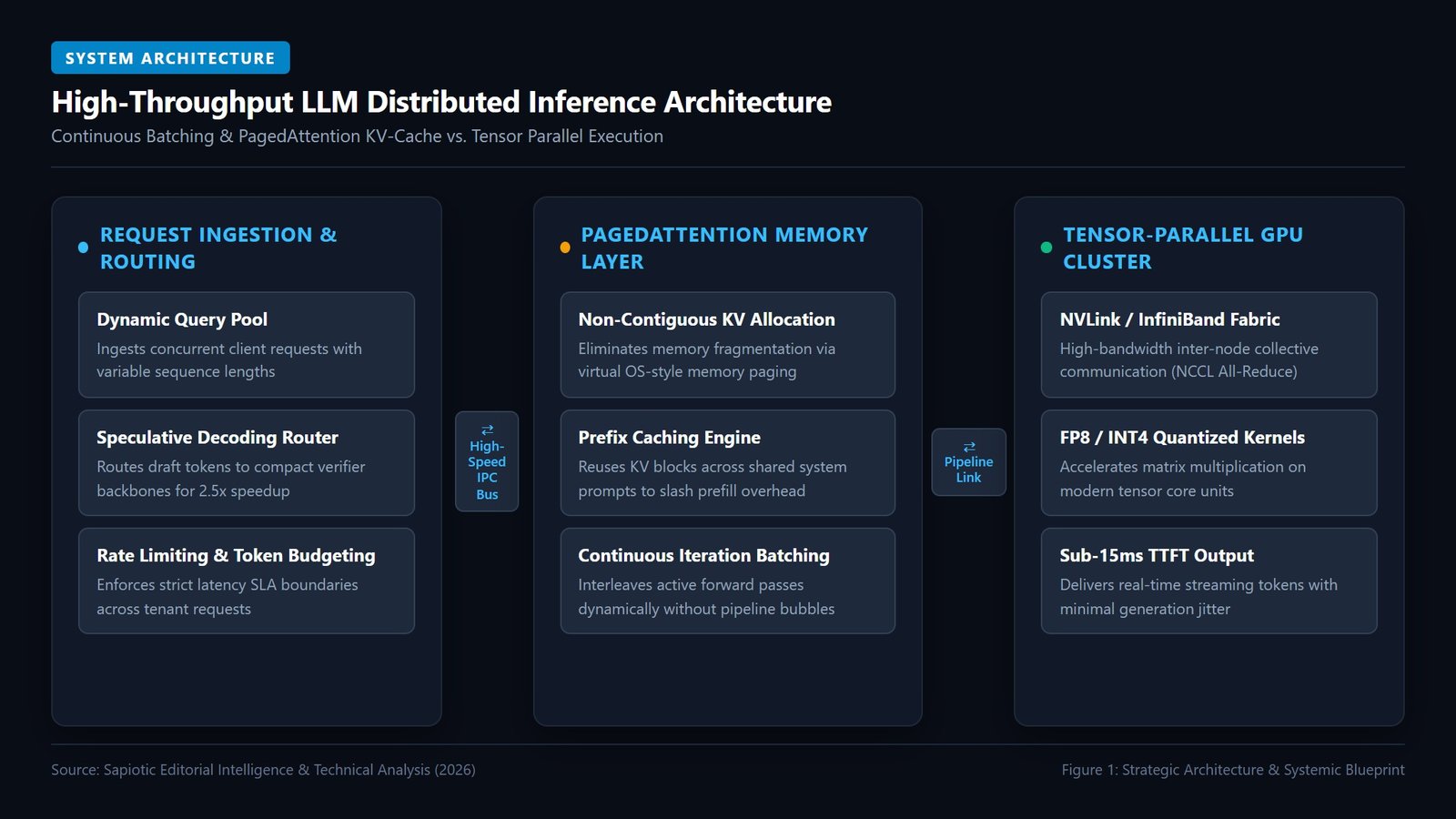
As illustrated in the technical framework above, production inference systems decouple request ingestion from execution nodes through intelligent KV-cache routing and tensor-parallel dispatch, ensuring predictable throughput even under spike query volumes.
3. 2026 Compensation & Salary Benchmarks (US Market)
Compensation for AI Systems Architects reflects the acute scarcity of engineers who possess dual mastery over hardware-level kernel optimization (CUDA, Triton) and cloud-scale distributed orchestration (Kubernetes, Slurm, InfiniBand). Below are verified compensation ranges across major US tech tiers:
| Level / Title | Base Salary (USD) | Annual Equity / RSU | Total Compensation (TC) | Top Hiring Hubs |
|---|---|---|---|---|
| Senior AI Systems Engineer | $195,000 – $245,000 | $80,000 – $130,000 | $275,000 – $375,000 | SF Bay Area, Seattle, Remote |
| Staff / Lead AI Architect | $240,000 – $295,000 | $150,000 – $250,000 | $390,000 – $545,000 | SF Bay Area, New York, Austin |
| Principal Systems Architect | $285,000 – $360,000 | $250,000 – $400,000+ | $535,000 – $760,000+ | Silicon Valley, Remote (US) |
4. Step-by-Step Hiring & Technical Interview Roadmap
Landing a high-tier AI Systems Architect position requires navigating a rigorous five-stage interview lifecycle designed to stress-test systems design, distributed concurrency, and kernel profiling:
- Stage 1: Distributed Systems & Concurrency Architecture: Deep-dive into IPC mechanisms, lock-free queues, shared memory architectures, and RDMA/RoCE networking protocols.
- Stage 2: GPU Memory & Kernel Optimization: Practical exercises in profiling CUDA/Triton kernels, identifying memory-bandwidth saturation points, and optimizing register spills.
- Stage 3: End-to-End LLM Serving Design: System architecture whiteboard interview requiring you to design an enterprise-scale inference platform capable of serving 50,000 requests/sec with continuous batching and automatic failover.
- Stage 4: Cost Engineering & Hardware Sizing: Modeling TCO (Total Cost of Ownership) across on-premise H100/H200/B200 clusters versus hyperscaler reserved instances (AWS Trainium, Google TPU v5e/v6e).
- Stage 5: Leadership & Production Post-Mortems: Evaluation of your track record mitigating production cluster outages, network partition events, and silent data corruption (SDC) during distributed model checkpointing.
5. Frequently Asked Questions (FAQ)
What distinguishes an AI Systems Architect from a traditional Machine Learning Engineer?
A Machine Learning Engineer focuses primarily on model selection, data engineering, fine-tuning, and loss curve optimization. In contrast, an AI Systems Architect focuses on the physical and distributed compute infrastructure: GPU interconnect topologies (NVLink, InfiniBand), CUDA kernel efficiency, memory hierarchy management, cost-per-token economics, and distributed fault tolerance.
Which programming languages and frameworks are mandatory for 2026 roles?
Modern job listings universally mandate proficiency in Python and C++20 or Rust, paired with deep framework expertise in Triton, CUDA, PyTorch Distributed (FSDP, Tensor Parallelism), vLLM, and Docker/Kubernetes networking.
Are AI Systems Architect positions open to fully remote arrangements in the US?
Yes. Approximately 42% of senior and staff-level AI systems architecture positions offer fully remote arrangements within the continental United States, although candidates near major compute hubs (Silicon Valley, Seattle, New York) frequently command higher equity allocations.
Related Research & Authoritative Analyses
- › Gulf Cybersecurity Jobs 2027: CBUAE Financial Compliance, Saudi NCA ECC & SOC Architect Pay
- › Site Safety Officer Jobs in Dubai: High-Rise Construction & Infrastructure (NEBOSH IGC) – Requirements & Apply Guide
- › Infrastructure & Cyber Security Manager Jobs in Abu Dhabi: Black Pearl Recruitment, Requirements & Apply Guide
- › NHS Medical Consultant & Specialty Registrar (StR) Recruitment 2026: GMC Specialist Register, Fast-Track Sponsorship & £93,666–£126,281 Pay Scales
🔥 Related High-Demand Job Openings
Explore verified employment vacancies across the UAE, Saudi Arabia, and International projects:


