The United Kingdom has embarked on one of the most radical infrastructure transformations in European history: the Clean Power 2030 (CP2030) mission. Spearheaded by the newly operationalized Great British Energy (GB Energy) entity and capitalized through the £7.3 billion National Wealth Fund, the mandate requires the complete decarbonization of the UK wholesale electricity generation system by 2030. Achieving this necessitates unprecedented capital deployment across North Sea offshore wind farms, next-generation Small Modular Reactors (SMRs), and a wholesale overhaul of the National Grid transmission network.
1. The Scale of the Decarbonization Mandate
To transition the national electricity mix to 95%+ zero-carbon generation within four years, the UK must execute infrastructure projects at four times the historic pace. Offshore wind capacity must quadruple from approximately 15 GW to 55–60 GW, solar PV must triple to 50 GW, and foundational nuclear capacity must be stabilized through rapid life-extensions and advanced modular procurement.
Great British Energy’s Capital Deployment Arms
- Co-Investment Facilities: Partnering directly with institutional investors to de-risk high-capital frontier projects, including deep-water floating offshore wind and green hydrogen electrolyzers.
- Local Power Plans: Deploying £1 billion annually to municipal authorities and community energy co-operatives to fund local rooftop solar and district heat networks.
- Supply Chain Industrialization: Rebuilding domestic manufacturing hubs in ports across Teesside, the Humber, and Aberdeen to capture turbine blade, tower, and subsea cable fabrication value.
2. Projected Energy Mix & Generation Capacity Trajectory
To evaluate how the UK generation fleet will evolve through 2030, the strategic capacity matrix below charts the planned expansion across key generation sources:
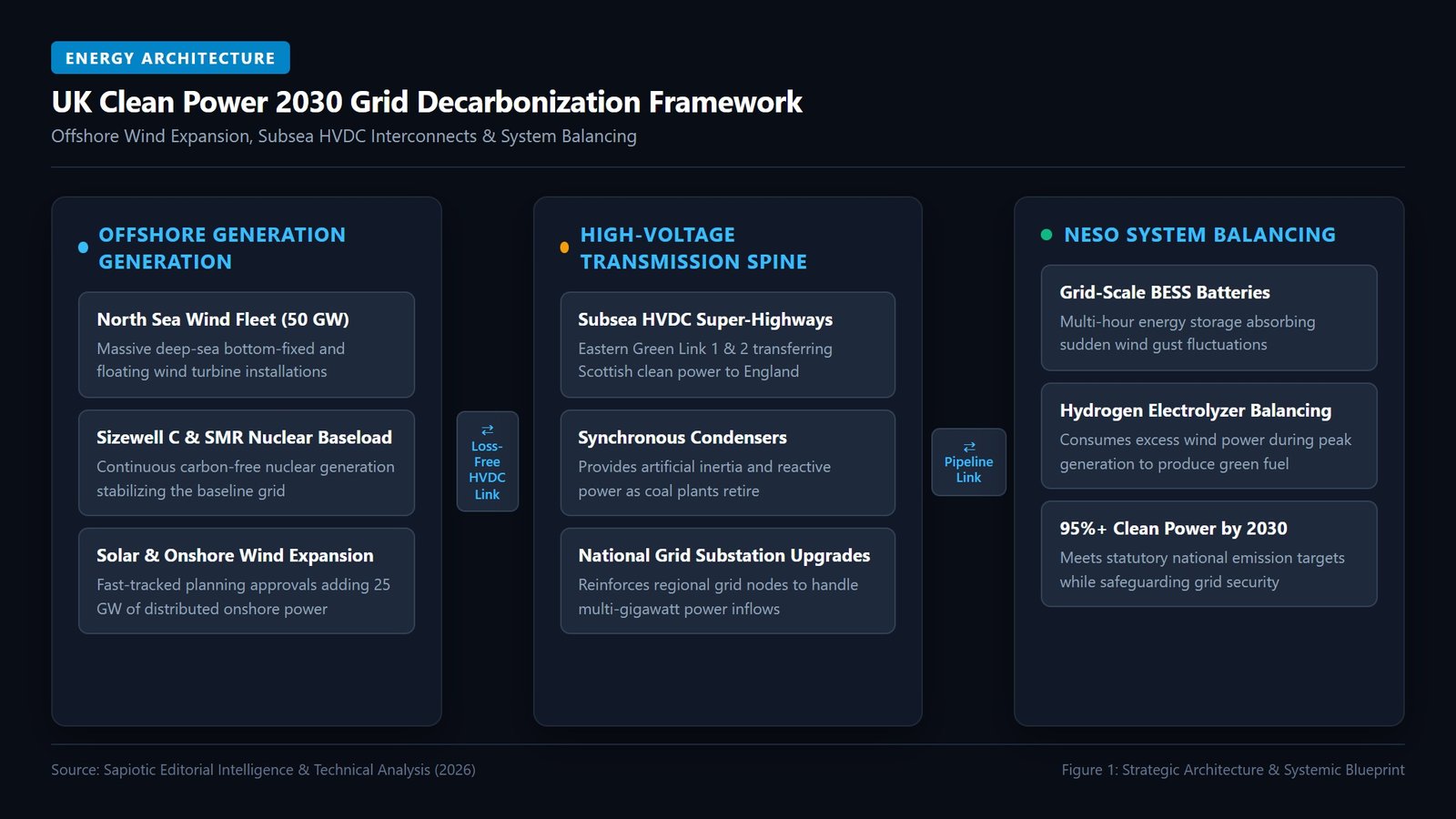
As detailed in the capacity chart above, the dramatic expansion of variable offshore wind generation necessitates a proportional expansion in long-duration energy storage (LDES) and low-carbon dispatchable capacity to maintain grid frequency stability.
3. Overhauling the Transmission Grid: The “First-Ready” Rule
Historically, the primary bottleneck stalling British clean energy was the National Grid’s legacy “first-come, first-served” connection queue, which left over 400 GW of projects waiting up to 12 years for substation access. In 2026, the implementation of the National Energy System Operator (NESO) framework has restructured queue management:
| Regulatory Dimension | Legacy Framework (Pre-2025) | Reformed NESO Framework (2026) | Impact on Project Timeline |
|---|---|---|---|
| Queue Prioritization | First-come, first-served (speculative applications blocked queue) | First-ready, first-connected (mandatory land rights & planning milestones) | Eliminates ~120 GW of phantom speculative applications |
| Planning Consents | Local authority appeals lasting 3–5 years for major pylons | Critical National Priority (CNP) status for high-voltage transmission lines | Streamlines DCO approval times to under 12 months |
| Subsea High-Voltage (HVDC) | Fragmented point-to-point developer connections | Coordinated Eastern Green Link (EGL 1 & EGL 2) multi-terminal super-grid | Directly routes 4 GW of Scottish wind power to southern load centers |
4. The Nuclear Renaissance: Rolls-Royce SMRs & Sizewell C
Because offshore wind is subject to meteorological “dunkelflaute” events (extended periods of zero wind across Western Europe), the government has prioritized firm, non-intermittent nuclear power. Great British Nuclear (GBN) has finalized the competitive selection of primary Small Modular Reactor (SMR) vendors—led by Britain’s Rolls-Royce SMR—to deploy 470 MW pressurized water reactor units at historic nuclear licensed sites like Wylfa in Anglesey and Oldbury in South Gloucestershire.
5. Frequently Asked Questions (FAQ)
Is the UK Clean Power 2030 target technically and economically achievable?
NESO modeling confirms the target is technically viable, but requires executing planning reforms, supply chain procurement, and grid construction at roughly four times historic rates. Natural gas plants with carbon capture and storage (CCUS) will remain on standby as strategic backup to guarantee security of supply during low-wind anomalies.
How does Great British Energy (GB Energy) differ from a traditional utility provider?
GB Energy is not a consumer-facing retail utility that sells electricity bills to households. Instead, it is a state-owned investment and operational company that co-develops, finances, and owns equity stakes in clean energy generation assets alongside private institutional capital.
What role will Rolls-Royce SMRs play in the 2030 clean grid?
Rolls-Royce SMR units produce 470 MW of clean baseload electricity using standardized, factory-built modular components. While the first operational SMR is projected to achieve criticality in the early 2030s, statutory approvals and ground breaking across selected sites in 2026 are locking in long-term baseload stability.
Related Publications & Curriculum Pillars


Related Research & Authoritative Analyses
- › Pakistan Clean Energy Transition: Thar Coal Rail Link, Hydel Megaprojects & Solar Net-Metering
- › US AI Datacenter Power Grid Crunch: Federal Energy Approvals & SMR Nuclear Deployment
- › Saudi Aramco Jafurah Gas Expansion 2026: Unconventional Shale Reserves, Blue Hydrogen & Petrochemical Feedstock
- › US Power Grid Modernization 2026: Small Modular Reactors (SMRs) & Nuclear Energy for Gigawatt AI Data Centers